Summer is supposed to be fun—a relaxing time for families. But parents can also feel very stressed in the summertime. You can begin to feel like a prisoner of parenting, while children become harder and harder to please. Welcome to the summertime blues! There are two forces at work: Unrealistic expectations of ourselves and a tendency to do too much for our children.
Mothers and fathers often have the expectation of themselves that they “should” make their children happy. These days, happy isn’t even enough; we think we should make them ecstatic. The self-imposed pressure to make one’s children rejoice in every moment of every day of their magical summer—and the guilt of not meeting such unrealistic expectations—can be overwhelming at times!
And this leads to another problem: By trying to meet their every need and desire, we are stopping our children from being able to follow their natural urges to do things for themselves. Adults often think that being a “good parent” means doing more and more for children, and that that will make them happy. But when we “help” children this way, they just get more and more unhappy, frustrated, fussy, and demanding—have you noticed?
Conversely, to raise a family of balanced, happy, generous children who are ready to contribute and who feel truly connected to others, is another way. When we look at the principles of the Montessori approach, we see a simple structure that guides us to give our children what they really need, and because this is based in natural development, it frees them and us, from the pressures of our current parenting culture.
This overall structure has three steps: Preparing the home environment, modeling the behaviors you would like to see in your children, and allowing freedoms and choices while providing simple boundaries.
Prepare Your Home Environment

Put your energy into preparing your home environment so that your children can be more independent from adults. There are always little ways to do this, in little bits each day. This will look like a “Goldilocks” environment if you have several children, and as you make adjustments to match their ever-changing levels of independence.
When you travel, look for ways to prepare the environment of any restaurant, hotel room, or beach house, so your children can take care of their own needs more and depend less on you. Once you get the hang of thinking this way, you’ll be amazed at how your children’s behavior may improve! The opportunities to explore their abilities and build self-confidence and independence will feed their needs more than any lollipop bribe or screen time. Our children are driven to progress by a fierce natural force; it is our job to support that innate drive by physically setting things up for them to succeed in the environment.
Model The Behaviors You Would Like to See
Model the interactions of grace, courtesy, and composure you would like to see in your children. This is always easier said than done! But if you make it a priority and restructure your day knowing you are doing the best thing for your family, it will pay off in spades. Get up a few minutes earlier to have just five or ten minutes of meditation, prayer, reading—whatever helps you set yourself up to be your best—before you come out of your bedroom and enter family life. (If your children can come into your bedroom and you do not have any place where you can be alone, well…start with changing that, right away!) Engage your children in the prepared environment by showing them how to start using the items you have set out for them, and then move on to your own activities and let them be as independent as possible. For children who are accustomed to having one-on-one adult attention, you may need to wean them off this expectation by getting busy in your own activities and letting them explore their own abilities before you help. Try to show your children how to do things in ways that allow them to do the actions, rather than you. Dr. Montessori pointed out that the child’s expression is “Help me to help myself.”
Allow Freedoms with Clear, Simple Boundaries
Allowing children to make their own choices and providing them with clear boundaries are two ways in which parents can simplify home life and help children become more independent. (For a more in-depth discussion of this concept of freedoms and boundaries, see our post Freedom and Responsibility: How Choices and Limits Help Children Develop Character.)
Here are some examples when away from home:
In the car, children have the freedom to talk, read, ask questions, look out the window, etc. The boundaries might be: seats belts on and no screaming. Whatever boundaries are important to you must be consistent and enforced. For example, I once had to pull over and get out of the car and walk away when my children wouldn’t stop screaming in the back seat. When they stopped screaming I walked back over to the car, calmly got in, and drove them home. Stunned, they sniffled the whole way home and never did it again. They realized I was serious when I said, “I don’t drive when passengers scream.” (Thankfully, it was the middle of summer and the Forest Bluff School parking lot was empty that day while I waited it out.)
In a public place, we have the freedom to talk, play games that don’t loudly distract others (card games, memory games, I-spy games, etc.) and to eat or not eat the foods served. Boundaries might be: we stay seated while eating and speak politely.
Freedoms usually go without saying and do not need to be stated, but boundaries should be very clear ahead of time and very few. Pick over-arching boundaries that are easy to understand, apply to a lot of situations, and make sense to anyone. When children are old enough to understand what negative behaviors are, then any harmful behaviors fall under one category. And it’s just a broad rule to remember and refer to, such as “Be kind, and do your part to help the family.”
When children are five years old and younger, it can be helpful having a checklist of just a few family guidelines: clean up your dishes, straighten your own room, and help to make dinner twice a week, for example. But as children get older, one rule can suffice: “Take care of yourself and your own things, and be helpful when asked.” If your child’s messy room doesn’t cause problems for others, seriously think about whether that might be something you can let go of in order to prioritize other, more important things.
The essential thing is your tone of delivery. If you truly believe in what you are asking of your children, and you envision the outcome you believe in—independent, caring, cooperative people out in the world—then you can say things with love and support your children with grace and compassion. Any of the above can be made ineffective by a tone of resentment, sarcasm, or punishment. This is why modeling grace and courtesy is so important. You are the leader of your family, and your behavior and mood sets the tone. You are the living model for your children. So set yourself right first, and the rest will make sense. (See Lessons from Montessori: Preparing Ourselves with Grace.)
Practical Suggestions for Preparing the Environment
If you find yourself feeling very frazzled at this point in the summer, I recommend just going back to step one and spending your energies there. Step back and see what changes you can make to enable your children to take care of their own needs more independently. Here are more suggestions for preparing the environment at home or when traveling:
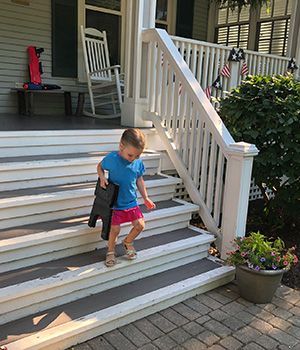
- Bring a portable step stool everywhere you go. (The low ones from the hardware store that fold up are great!)
- Bring a tiny potty everywhere you go if your child is too small to climb on a toilet without your portable stepstool.
- Bring a child-sized cup and child-sized pitcher so your children can use these items in restaurants and vacation places. (Available online at com)
- For a trip, let each walking child carry his or her own child-sized backpack of supplies and roll-away suitcase, and only bring the clothes that fit inside. (Plan to show your children how to wash their clothes partway into the trip—by hand/hang dry or in a machine—to make packing light/child-sized.)
- If traveling, have 2 books, 2 small toys, or 2 games/card sets and drawing supplies for each child in his or her own backpack. Less is more! In my family, we used to save the undesirable toys and books we were given over the years and bring them out on the plane or in the car; these were called “travel toys” in our house. These were exciting, with all the bling, and we didn’t care if they got lost along the way. When we got home, they disappeared and re-emerged on the next trip.
- Put needed items within reach so your children can take care of themselves as much as possible everywhere you go. In every kitchen, prepare a low shelf or cabinet with a set of bowl, plate, cup and utensils, a sponge or rag for wiping up, and a tiny hand brush and dustpan to clean up the floor after themselves. Far from being “chores,” these activities of independence and contributing to group life become enjoyable and give children a home-away-from-home familiarity. Doing this also releases you from the constant demand to attend to the children’s needs.
- Help your children prepare a few healthy snacks in small containers or baggies on a low shelf in the refrigerator so that they can get something to eat when they are hungry, later on.
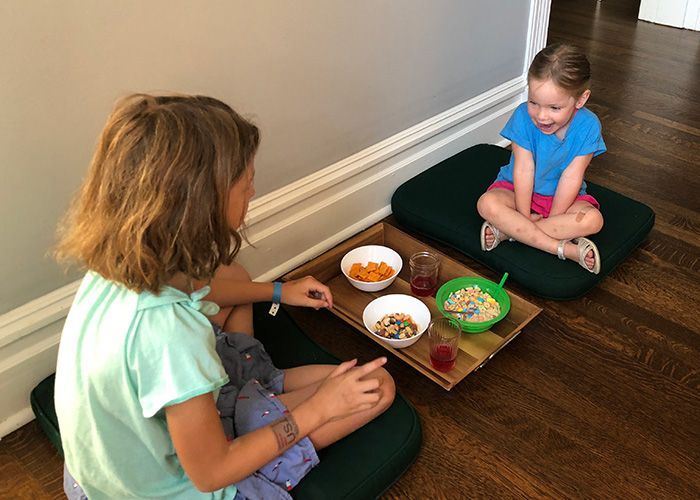
- If possible, make a kitchen area for the children that is safe and low to the ground. If there is no child-sized furniture, you can to do this by placing outdoor cushions on the floor as seats and a large serving tray to be their table for eating (see photo).
By having a creative mindset when setting up the environment, you make tiny pockets, or moments, for yourself to read another few paragraphs in a book or relax. Just as important, you free your children to be more pleasant for other adults to be around. You ultimately prepare them to be less frustrated and more capable, cooperative, and participatory in group living.
Dr. Montessori said that when we give unnecessary help, we hinder our children’s development. She wrote, “…the first task of education is to furnish an environment which will permit and aid the child to develop the functions given him by nature. This is not a question of merely pleasing the child, but of cooperation with a command of nature. Observation of the child shows that normally he has the desire to act independently; he wants to carry things, to dress and undress alone, to feed himself…In giving…independence to the child, we free a worker who is impelled to act…” (Education for a New World).
Taking this in mind, prepare the environment a little bit every day, take care of yourself so you can be a living model, and watch your children blossom into the happy people you hope they’ll become.