Our Living Land Laboratory
Paula Lillard Preschlack • August 1, 2018

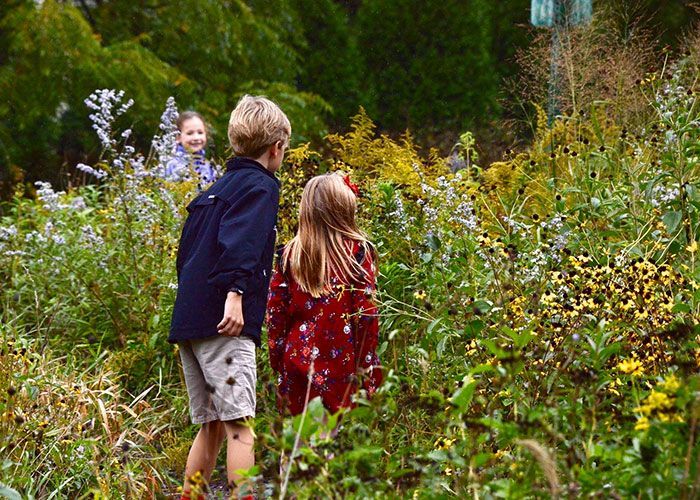
If you happen to drive past the school this summer, I encourage you to take a peek at the amazing prairie and everything growing there. This is our “land laboratory” for our children to explore and research in September and throughout the year, building their scientific interests and connections with the natural world. Through the immediate examples in nature, our children notice the interrelatedness of everything and learn about the laws of nature that create balance and respond to imbalances.
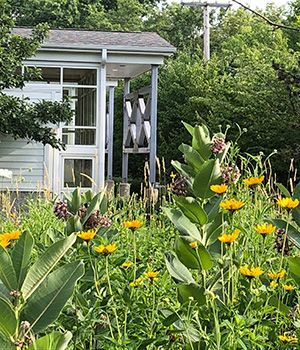


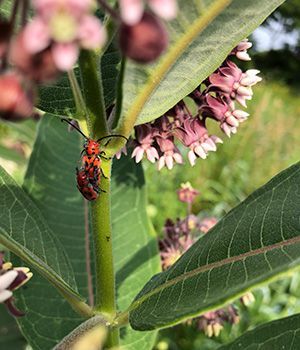
Our prairie gives children the direct contact they need to develop a love for nature and to discover the amazing variety that the natural world presents to us. The Young Children’s Community and Primary children can observe, touch, smell, and collect specimens of all shapes and sizes to fulfill their incessant quests for knowledge. The Elementary-aged children—so full of questions and analytic ideas—can take samples, classify, and design experiments to share their results with others. Our Secondary Level students can take leadership roles by becoming stewards of this land, and go beyond our immediate resources to seek advice from experts and check the health of our prairie’s ecosystem with the larger one in our state and part of the world.


In these broad stages of investigation and care that corresponds with children’s developmental stages, the land laboratory we have on our property provides the stepping stones that ignite interest in earth’s ecosystems and real, original opportunities for children to follow their own ideas for their learning.
Dr. Montessori guided educators to provide stimulating environments where children can learn by following their urges to explore, ask questions, and investigate, and thereby give themselves a personalized and much fuller education than adults could give with the simple relaying of pre-determined information. Dr. Montessori wrote, “We do not want complacent pupils, but eager ones; we seek to sow life in the child rather than theories…The secret of good teaching is to regard the child’s intelligence as a fertile field in which seeds may be sown.”


Because children are constantly trying to adapt to their surroundings, it is imperative that we give them a sense for the whole of our surroundings, so that they may find their places in relation to not just their family, their school, or their town, but to the whole of this world that even our little patch of prairie is connected to and responds to. Our children do much of their work on the subconscious level, which makes direct contact with the natural world even more important, at each stage of their lives.


Our Forest Bluff directors and our on-site naturalist, Abbey White, look forward to greeting your children in September and supporting their scientific, artistic, historic, mathematical and linguistic investigations through our living land laboratory!
A teacher and Montessori student at Forest Bluff School in Lake Bluff, IL, shake hands.
By Alice Davidson with contributions by Margaret J. Kelley February 25, 2026
In Montessori education, we view each child as inherently capable of developing a strong sense of right and wrong. A child’s moral compass is not something we impose upon them—it is something that grows within, guided by experiences, reflection, and consistent modeling from the adults in their lives. For that moral sense to take root, children must be allowed to experience accountability for their actions. When parents shield their children from consequences or defend behavior they know is wrong, they unintentionally undermine that process, creating confusion and instability in the child’s understanding of truth, fairness, and responsibility. Many parents defend their children out of love and protectiveness. They wish to spare their child from discomfort, embarrassment, or the feeling of failure. Yet this kind of protection, though well-intentioned, teaches the opposite of what true love demands. One of the tenets of Montessori is to put children in contact with the real world in age-appropriate ways, trusting that they have the inner capabilities to grow and adapt when they have real experiences. When parents constantly justify, minimize, or excuse poor behavior, a child misses an opportunity for feedback; they learn that honesty is flexible and that integrity can be negotiated. This erodes their moral foundation and leaves them uncertain about what is right—not because they cannot feel it, but because the adults they trust most are contradicting that inner voice. In Montessori, children learn to do work and make decisions based on intrinsic, not extrinsic motivation. We trust that they have goodness inside of them, and while they absolutely need guardrails and guidelines, we can best serve them by teaching them to distinguish between their internal drives, and to take action in accordance with their conscience. Children are perceptive. They often know when they have done something wrong—whether they spoke unkindly, acted selfishly, or disrespected another. When their parents immediately defend them or blame others, the child experiences an internal conflict. On one hand, their conscience tells them they made a mistake; on the other, the parent’s response tells them they are in the right. Over time, this mismatch between inner truth and external validation creates confusion. The child begins to question their own moral instincts and may even learn to ignore the pangs of conscience altogether, relying instead on external approval to define what is acceptable. This is one of the greatest harms of over-defending a child: it separates them from their natural moral compass. When children are consistently told they are right—even when they know they are not—they start to equate love with being defended rather than being guided. They may learn that relationships are maintained through justification and blame-shifting instead of honesty and repair. Later in life, these patterns can manifest as difficulty accepting feedback, resistance to authority, or an inability to take responsibility in personal and professional relationships. In Montessori classrooms, we see accountability as a cornerstone of growth. When a child makes a mistake—perhaps they take another’s materials without asking or speak rudely to a classmate—we respond not with shame, but with calm guidance. We help the child reflect: What happened? How did this affect others? What can you do to make it right? This process nurtures empathy and clarity. It helps children see that they can correct their mistakes, that doing wrong does not make them bad, and that making amends restores both harmony and self-respect. Accepting that your child can be wrong is not a sign of parental failure—it is a sign of courage and wisdom. When you model accountability yourself, your child learns that truth is not something to be feared. They see that mistakes are part of being human, and that integrity means facing them with grace. Ultimately, allowing your child to experience and accept the consequences of their behavior builds confidence, empathy, and moral clarity. Shielding them from accountability may protect their feelings in the short term, but it confuses their conscience and weakens their inner sense of right and wrong. By guiding them lovingly toward truth and responsibility, you empower them to grow into kind, honest, and self-aware individuals—qualities that form the true foundation of a moral life.
A Montessori student at Forest Bluff School uses grammar symbols and color-coded tiles
By Margaret J. Kelley January 24, 2026
Discover how Forest Bluff School on Chicago's North Shore uses Montessori symbols to teach grammar, making language arts engaging for Primary and Elementary students.