We think different things when we hear the word diversity. Some may think of variety in skin color or socioeconomic backgrounds, others may think of different languages or cultures. Whatever your family, community, or school is like, understanding and embracing diversity and building connections between people is imperative. I am not an expert on diversity but will share how I believe Dr. Montessori’s approach guides and helps children to appreciate and value human diversity.

Consider what diversity means. In nature, we see that diversity indicates strength and balance: In a prairie for example, diversity among plants and animals creates a healthier, sustainable system, making them more resilient to environmental changes. Beyond being beautiful to look at, a diversity of prairie flowers is more attractive to the insects and wildlife these plants depend upon. In short, plants and animals work symbiotically to make a stronger ecosystem, able to withstand adversity and capable of sustaining life over many generations.
With human beings, this is true as well. When diverse peoples come together over a common cause, the symbiosis of their ideas reaches improved solutions. In The Innovator’s DNA: Mastering the Five Skills of Disruptive Innovators,Jeff Dyer, Hal Gregersen, and Clayton Christensen found that innovators get their ideas from interacting closely with people who think and behave differently from how they themselves think or behave. In other words, we cannot come up with new solutions if we do not associate, question, observe, network, and experiment. This means that getting together with people who are different from oneself, and sharing what is different, is imperative to building compassion, solving problems, and fostering creativity.
This is exactly what happens in Montessori classrooms every day. Children are encouraged, by the Montessori approach, to be open to new ideas, to seek to understand one another’s perspectives, and to see the value of synergy. In a Montessori classroom, students make associations between subjects and topics; they ask questions constantly, embodying the Socratic method in every learning opportunity. Our students learn to observe first, and to look and to think, during their three-hour uninterrupted work periods every morning. They network with each other by interacting and finding out what one another is thinking. And they experiment as they create, whether it be with a Montessori material they have just been shown, or when testing an idea they’ve come up with.
Montessori's Approach
The cooperation of peoples working together was championed by Dr. Maria Montessori. Her educational philosophy and the lectures she gave around the world reflected her deep belief in the universality of human beings and the importance of working together in harmony. (She was so committed to this belief that she referred to herself as a “citizen of the world”—not wanting to be defined by a single creed, nation, or religion—and requested that her final resting place be wherever she happened to die, as a demonstration of the universality of her educational philosophy. Montessori is buried in the seaside village of Noordwijk in the Netherlands, where she died at the age of 81 while staying at a friend’s home.)

Montessori had realistic ideas and a deliberate plan for how teachers could help children to develop a spirit of inclusion within their own classrooms. In Education and Peace, Dr. Montessori wrote, “Peace is a goal that can be attained only through common accord, and…establishing peace is the work of education. We must convince the world of the need for a universal, collective effort to build the foundation for peace” (p. 24). Being open to diverse peoples and differing ideas begins by practicing these behaviors in one’s immediate community, as a child.
To help children understand that human beings are stronger when they work together, Montessori first establishes—“How are we alike?” This context, established from the beginning, is that we are all, first, human beings, no matter where or when we were born, what our customs or religious practices are, or how we may look. Children develop a sense of closeness, respect, and identity with each other as fellow human beings.
Dr. Montessori noticed that when children follow this line of thought, their own awareness and appreciation of others emerge, and they delight in finding differences. This way, diversity is a discovery of “Wow, look at that amazing way these peoples have found to meet their own human needs, in a different environment, culture, or religion.” They have a feeling of familiarity before they examine differentiation.
The Montessori Materials and Presentations
One of the ways this occurs is through the context of accounting for the whole world. When children are three years old, for instance, they hold their classrooms’ small globes in their hands, and learn the names of the oceans and the continents. They learn the names of the countries of the world on the large, colorful puzzle maps, tenderly placing each piece in its place and saying the names that are so interesting and beautiful: Mozambique, Pakistan, Guatemala. In these first, impressionable years of their lives, the Montessori children fall in love with the world and its words. They look at photographs of peoples from around the world in the Geography Folders and absorb the numerous ways of dressing, the different geographical settings of desert or jungle, and see the animals that live in various climates. These images all sink into their unconscious, absorbent minds in a stage of acceptance and enthusiasm for sounds and sights, before they have any cultural prejudice or hesitations to act on.
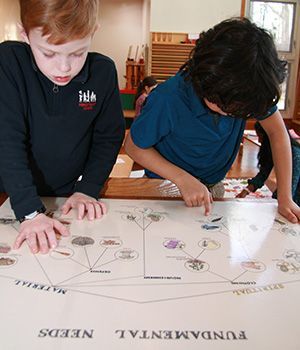
In the elementary classroom, children ages six to twelve learn about the earliest humans in context of the creation of the earth and the evolution of life forms. They ponder and discuss how the first humans must have lived, what challenges they must have faced, and how they must have worked together to survive. The love that bound humans together in cooperative relationship to one another, the hands they could use to build tools, and their minds that could think, create, and imagine, are emphasized by the teacher to guide the children in their own wondering and questions. The students learn about the Fundamental Needs of human beings (food, shelter, transportation, defense, clothing, artistic and spiritual expression) by asking questions and following their curiosity. In their explorations and research, elementary children discover the different, clever ways that human beings meet these universal needs. Students look at the clothing, shelters, or foods of each culture with the eye of appreciation for humans’ collective fundamental needs.
Interestingly, we rarely hear reactions of “Eeewww,” even when the children find that in some cultures, people eat very different things, such as insects. Instead, it is more common to hear “Wow…I wonder what that is like!” There is an openness and a connection made by the realization that first, we are all human beings. A Montessori child thinks, “That person is a human being just like me. He developed tastes for foods as a child, just like me. He gets food from what is available around him, finds shelter from what is available, clothes himself in ways that protect him against the climate or to express his beliefs in the supernatural. By doing these things, he looks and acts differently from me. How fascinating—I want to know more!”
Religions and Celebrations
One area of finding similarities and differences is in spiritual and customary practices. In Montessori, exploring religions and cultures is part of the curriculum all year round. This is directed by the children’s curiosity. Their explorations of religions and customs connect to any area of the classroom.
For example, at Forest Bluff School this fall, students were invited, by their classmates, to learn about Diwali traditions and participate in celebrations. Some students generously taught their friends how to make rangoli, a traditional Indian art form that is made during Diwali and other Hindu festivals to symbolize good fortune and divine blessings. They invited classmates to light the candles in the beautiful brass diya in the school’s entranceway. Each day of Diwali, groups of children gathered and took turns lighting the candles. When acknowledging spiritual life in this fashion, a respectful hush falls over the children. They are pensive and observant. They respect one another.
Such spontaneous experiences differ from teacher presentations. In other settings, teachers may give a prescribed lesson to the entire class about a religion or culture; What we see, by contrast, is an intimate act of children learning from one another, in friendship and companionship. This personalization leads to a lasting openness for other cultures and a willingness to connect and identify with peoples around the world.
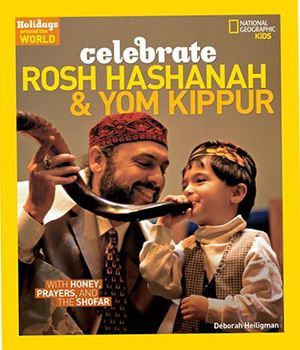
Montessori children likewise delight in learning about the history and customs of Jewish friends who celebrate Rosh Hashanah, Yom Kippur, and Hanukkah. Students are curious about their own heritages and those of their classmates. This evolves into many explorations and studies when the children reach their elementary years.
When Eid and Ramadan come around, children are eager to learn about their Muslim friends’ beliefs as well. Sometimes a teacher will begin the conversation by reading a book to the children about a religious celebration, and other times the children begin the discussion themselves. Sometimes a topic takes on a life of its own and the children pursue it in depth, and at other times, an event may only generate a little interest. But the children learn more each year as the calendar brings religious events and customary celebrations into view, again and again. The children love to learn the stories that belong to each religious event and the symbolism that corresponds with each.
Interestingly, when the topic of diversity is approached with this inclusion-first orientation that Montessori proposed, children notice the similarities between different religions very quickly. We see them point to what religions have in common:
-extended-family gatherings
-roles of respect for elders or special roles for certain family members
-candlelight
-sweets, special foods
-certain colors to symbolize something
-singing and/or dancing
-helping those less fortunate
-expressions of gratitude
-love and peace
The children delight in this realization: Major religions share so much in common! From this commonality, they then become fascinated by the specific differences that give each celebration or religion its character. Each one is special.
We find different ways to embrace different religions. This is an evolving process, one that never ends. For example, this year we learned Hanukkah songs and started to sing them with the children when talking about Hanukkah. Children in one classroom celebrated Diwali together by having a special lunch one day. At Christmas time, our school has a tradition of singing three Christmas hymns and Dona Nobis Pacem, a non-denominational song with Latin text that means “Grant us peace.” Students who are agnostic, atheist, Christian, Hindu, Muslim, Bahá’í, Buddhist, and Jewish gather together in our hallway for this event. It is a treasured moment where our school enjoys a harmonious feeling of togetherness, one that transcends all religions and differences.
In all of their singing, creating artwork, reading books, and learning together about religions and customs, the children share an appreciation for one another’s heritage and practices with a reverent tone. For anyone who hopes for a better world, seeing children take such interest and respect for one another’s differences is deeply moving. When speaking of war and strife, Dr. Montessori said, “An education capable of saving humanity is no small undertaking; it involves the spiritual development of man, the enhancement of his value as an individual, and the preparation of young people to understand the times in which they live” (p. 30 Education and Peace).
Diversity in Topics of Study
Children are naturally curious. Because Montessori children are free to choose topics of interest to research, there is great diversity in their work as well. Montessori’s collaborative educational approach makes room for intellectual diversity because there isn’t a predetermined curriculum that everyone must get through in a designated amount of time. If children want to investigate a language, religion, culture, or custom, there is encouragement, time, and space for that to happen. If they want to extend their learning further by planning to go out to see more—to the Dusable Museum of African American History, the Field Museum’s exhibits on various ancient cultures, or the Art Institute’s various exhibits from around the world—they can do so. The opportunities are limitless! When they do this, children find great value and meaning in these excursions because each is a personal quest, rather than an assignment from someone else’s agenda.
Unique Individuals Make Up Communities
Children in Montessori learn to look for the connections between any “us” and any “them” to find first what makes everyone human beings, before examining what makes us different. In the end, what makes us different might be the most important part of a relationship. For instance, when a child stands up for what he or she believes in, they are brave for being different. Becoming a community of different individuals is what makes us like a healthy prairie, one that grows together and synergizes for strength.
Appreciation for diversity is the result of inclusion. First, we must include, in order to gain proximity for understanding and fostering relationships as individuals. By beginning with inclusion and emphasizing human similarities, children come to see that they, too, create a beautiful balance in their differences, with respect for the value each person contributes. And most of the time, this all happens unconsciously, until it becomes conscious. Most important of all is that Montessori children develop a natural appreciation and respect for all peoples. This comes from the purity of their young hearts, and through the approach of Montessori education.

Resources
Please find out when and what your friends are celebrating in their various religions and cultures:
Major Religious Holidays and Observances 2020-2021
National Geographic Holidays Around the World Book List
References
Montessori, Maria. (First published 1949). Education and Peace. Vol. 10, The Clio Montessori Series, Montessori-Pierson Publishing Company.