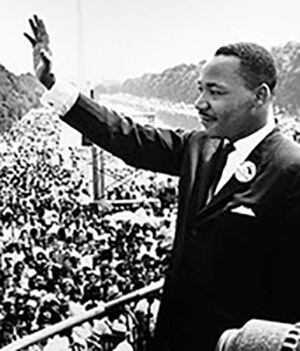
On Monday, January 18, 2021, our nation remembers the life of Martin Luther King, Jr.—a man who dedicated his life to seeking equity for all of humanity. The events of this past year have reminded us that we are best able to serve this goal when we listen, learn, and focus on the positive moral development of children.
Here, we re-post a blog written one year ago that reflects on the connections between Dr. King and Dr. Montessori, and shares the many ways that the Montessori approach supports Dr. King’s beliefs about peace and equity.
A Shared Vision of Peace
The arc of the moral universe is long, but it bends towards justice.
— Dr. Martin Luther King, Jr.
Establishing lasting peace is the work of education; all politics can do is keep us out of war.
— Dr. Maria Montessori
As millions around the country celebrate the life and legacy of Dr. Martin Luther King, Jr., we have an opportunity to consider his lasting impact in our lives: how we may honor his teachings throughout the year as well as in our daily practices; and the symbiosis that exists between Dr. Martin Luther King, Jr.’s and Dr. Maria Montessori’s teachings. While there is much that can be written about the overlap between these humanitarians’ philosophies and work, here we offer a brief reflection on how we embrace Dr. King’s values in a Montessori community.
Martin Luther King, Jr. shares his vision for peace
In Michael K. Honey’s edited collection of Dr. King’s speeches All Labor Has Dignity, he describes three phases of Dr. King’s civil rights movement. The third phase, tragically shortened, focuses on human rights. As Dr. King said in 1961 during his speech at the United Automobile Union, “A society that performs miracles with machinery has the capacity to make some miracles for men if it values men as highly as it values machines.” He famously repeated his belief that the dream for humanity and peace could be realized, “For although the arc of the moral universe is long, it bends towards justice.”
While not nearly as prominent a civil rights leader as Dr. King, Dr. Montessori was also a humanitarian. A similar pattern is seen in Dr. Montessori’s life work, as she moved from establishing a process for education to calling the world to action by embracing an education founded on equity and peace and centered on the needs and characteristics of the child. In a collection of her lectures, Education and Peace, Dr. Montessori states, “An education capable of saving humanity is no small undertaking; it involves the spiritual development of man, the enhancement of his value as an individual, and the preparation of young people to understand the times in which they live.” Her development of and advocacy for an education for peace led to three consecutive nominations for the Nobel Peace Prize.
This shared commitment to the inherent good in humanity and the vision of peace means that, beyond a day or month of recognizing Dr. Martin Luther King, Jr’s impact, we strive to embrace that philosophy in practice throughout our lives. In the classroom, this can be seen through: valuing classmates’ contributions to the community; studying human history through a lens of gratitude for the diverse peoples and civilizations that have contributed to making the world what it is today; examining historical time periods and events with an understanding of context; exchanging ideas and striving for mutual understanding, in collective, respectful conversations; and through service to others.
Valuing Classmates' Contributions to the Community
“Life's most persistent and urgent question is, 'What are you doing for others?’”
— Dr. Martin Luther King, Jr.
“The consciousness of knowing how to make oneself useful, how to help mankind in many ways, fills the soul with noble confidence, almost religious dignity.” — Dr. Maria Montessori
We see the respect of work—of human contribution— throughout the Montessori community. This begins at the youngest ages, where children’s natural capacity to find joy in contributing is encouraged. Children as young as 18 months old are given daily opportunities to work in ways that benefit the whole class: washing windows, watering plants, preparing food and setting the table for a communal meal, and so on.
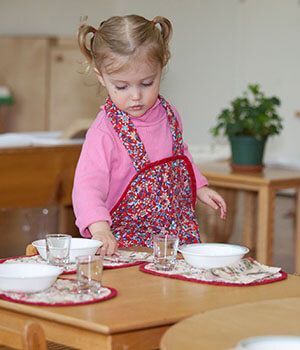
Children in Montessori each have responsibilities for the care of the community, ranging from ensuring they replace work items to carefully polishing and dusting shelves or caring for classroom pets. The mantra of the classroom becomes “We are all responsible for the well-being of the community.” This can be seen in small acts, such as when a child recognizes that a peer needs assistance and offers it kindly, or when an older child holds open the door for the family of a toddler. It is also seen as the Young Children’s Community shares meals together, passing food to one another, each ensuring that there is enough to feed the whole group before taking seconds; or by waiting to eat until everyone has been served and a collective thanksgiving is said to express gratitude for their meal and the joy of sitting among friends. Following the meal, the students are responsible for cleaning up after themselves, and there is a flow of movement as they take turns washing their dishes, wiping remnants of food from tables, and returning chairs to their place—everyone doing their part and understanding that each task, however small, is for the benefit of all.
Studying History Through a Lens of Gratitude
As children enter their Elementary years, they become more cognizant of social constructions and patterns, and are exploring moral values and behaviors both within themselves and in the world around them. This is the same age at which children in Montessori are formally introduced to human history and the beginning of society, with an emphasis on gratitude for those individuals who have helped create the society we live in today—both those deemed “significant” (i.e. renowned historical figures) and “ordinary” (the average human in a certain place and time). Just as Dr. Martin Luther King, Jr. and Dr. Maria Montessori urged society to recognize the dignity of all work and value the contributions of all, no matter their task, Montessori students are encouraged to view human history through a lens of gratitude for the individuals, known and unknown, who helped create a better society for us living in today’s world. Many of the early Montessori Elementary lessons are designed to appeal to the child’s natural tendency to engage in hero worship, often serving as a launching point for the child’s further independent research. The Montessori child does more than ask “What can we learn from these people?” or “How is my life experience alike and/or different from theirs?” They also thank them for their contribution to society.
In the Lower Elementary, many of the Great Lessons emphasize the theme of one-ness. They identify what humans throughout time and around the world have in common with one another. The children study a diverse array of world civilizations, influential leaders, and change makers. From an early age, the children are asked to investigate these individuals by assessing what Dr. Montessori referred to as their “fundamental human needs.” These are the core entities and values that all human beings have in common, regardless of their place in history or geographical location. For example, they will discover how the individual or society satisfied their needs for food, shelter, self-defense, transportation, and even their spiritual needs. The Montessori Fundamental Needs charts can be applied cross culturally, demonstrating how all humans share the same sets of needs.
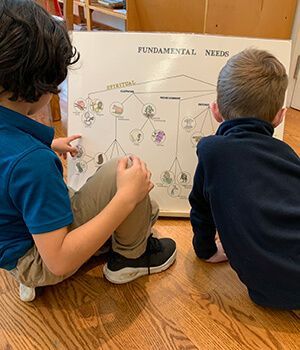
The three Great Lessons specific to human history—The Coming of Human Beings on Earth, Communication in Signs, and the Story of Numbers—and the key lessons that follow from them are given regularly throughout the school year; these lessons are the springboards from which the children often do more in-depth research of their own. This work is designed to highlight the universality of the human experience. For example, The Story of the Coming Human Beings specifically identifies how all humans are special due to hearts that can love, minds that can think, and hands that can create. The key lessons on The Interdependencies of Human Beings in Society highlight the individual humans who contribute to our daily life, often times going unnoticed. These lessons focus on individuals working together both to create a product for the greater good and to serve the community.
By first identifying our commonalities, such as our fundamental human needs, the children connect themselves to the individual or individuals being studied. They then recognize and explore the innovative or alternative ways in which these needs were met. As they investigate the life experiences of these diverse societies or influential individuals, the children are not only able to learn the tactical means by which these people brought about change, but more importantly they feel a connection to them, and an overwhelming sense of gratitude for the work they’ve done or continue to do.
In celebrating a particular transformative individual, or hero, such as Dr. Martin Luther King, Jr., the children engage in more pointed activities surrounding the individual’s work and his or her tremendous impact on the world. They utilize Dr. Montessori’s approach to human history as they ask why Dr. King, for example, needed to fight for change, and they investigate how he did so. Some students may choose to write a play, research other civil rights activists, or seek out a local expert. They celebrate with a deep sense of gratitude and admiration for both Dr. Martin Luther King, Jr. himself, the people he advocated for, and his message of peace and equality.
Understanding Historical Context
Montessori students are encouraged to dig deep into historical context, finding the connections between events, movements, and messages. For example, an Elementary-aged child learns that grandparents of his close friends did not have the ability to vote in the Southern states due to being born African American. This insight brings about questions regarding voting status, the history of civil rights in the United States, and research into current civil engagement regarding everything from access to voting to how the electoral college is structured. The world is open to explore because a community that embraces humanity, embraces questions and investigation.
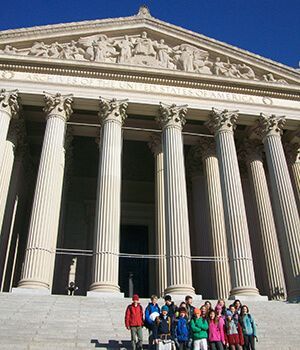
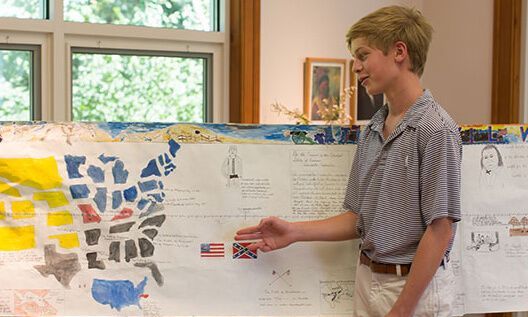
New ParagraphIn the Secondary Level at Forest Bluff School, during history and literature discussions and through a civics trip to Washington, D.C., students spend time thinking about the history of slavery in the United States and tying that history to the ongoing Civil Rights Movement. They go beyond research conducted at the Elementary Level and delve into the historical context of events and movements, allowing them to see the connections across time periods and to confront some of the more complex topics in our world’s and nation’s history. For example, the implications that our founders were great leaders and thinkers, and that they were fundamentally flawed as slave-holders is something that our students do confront. They read source material such as John Locke, the Constitution, Abraham Lincoln, Jefferson Davis, and Justice Taney's Dredd Scott decision. These primary sources are approached with a critical eye towards meaning and interpretation.
By the time they study the Civil Rights Movement, the students have a context for understanding its significance; they can see for themselves how the important work of Martin Luther King, Jr. and other leaders of the Civil Rights Movement is directly connected to and shaped by the time period from the founding of our nation up through reconciliation and reconstruction after the Civil War. When history is contextualized in this way, the people who make it are better understood and appreciated for their complexities and heroism.
Respectful Conversations & Mutual Understanding
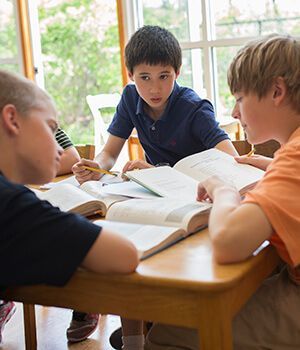
When students acknowledge and express gratitude for the contributions of their classmates and the humans who came before them, they are better equipped to approach their differences and conflicts from a place of mutual respect. Students in a Montessori classroom are empowered to constructively work through their differences in peaceful dialogue. Such conversations are critical to the students’ development of problem-solving and conflict resolution skills that they will use throughout their adult lives. At Forest Bluff School, students are provided freedom to responsibly cooperate inside and outside the classroom on a daily basis. Students self-organize into small groups to pursue research interests, solve a detailed math problem, create music on the Montessori Bells, etc. This cooperation is also practiced as they organize small groups for playing outside. When working and playing together, students practice listening to one another, coming to a mutual understanding, and compromising on a path forward—skills that are essential to the continued progress toward a more just, humane, and peaceful society.
In Service of Others
Both Dr. King and Dr. Montessori believed that a life lived in service of others was a life well-lived. The vision of peace that both luminaries promoted is only possible through action, or service, that is based on the respect, understanding, and gratitude that has already been established. As the child grows, their foundation in valuing humanity can be seen through service-oriented work and experiences. Because Montessori children of all ages internalize the importance of contribution to the classroom community, it is only natural for them to apply that mentality and behavior to the community at large.
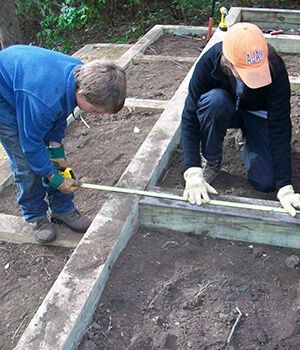
Service work is an integral component of experiential learning trips at the Secondary Level at Forest Bluff School. In the past few years, for instance, students have worked together to build an amphitheater, archery shed, canoe racks, and a scenic lookout for a YMCA camp that offers year-round programming in support of youth development, healthy living, and social responsibility. Completing an arduous task from beginning to end for the sake of contributing to the greater good gives adolescent students perspective. Such experiences impress upon them the enormous amount of collaboration and hard work that is required to build a highly functioning, just society.
An Enduring Message
In reading speeches from both of these humanitarians, there is a clear and present theme that important work remains to be done. As we enter a new decade, the time to heed Dr. King’s and Dr. Montessori’s words is still upon us. It is through our collective efforts, that we will continue to work for a more equitable, peaceful, harmonious society. As we teach our children and build our families, we have many opportunities to further this growth and practice peace in our homes, schools and communities.