When You’re Feeling Discouraged…
When you ingest the popular news these days, you may feel very down, anxious, angry or helpless. I know I certainly do. But when I turn to see the natural world around me, the beautiful people, and especially children, I am instantly reminded of the good in the world. Maria Montessori’s vision of children’s education–and the more peaceful world she proposed would result–always inspires me and gives me strength. Lately, I have learned of some very exciting initiatives happening all around the world because of Maria Montessori! These programs are being enthusiastically embraced and are growing steadily. Any involvement with Montessori–even if it be just mentioning it to others, raising your children with a Montessori approach at home, or sending your children to a Montessori school–includes you in this path of making the world a better place!
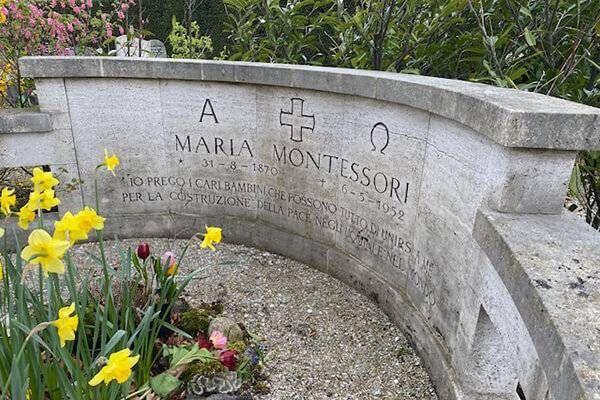
Maria Montessori’s gravestone reads: “I beg the dear, all-powerful children to join me in creating peace in man and the world.”
A Worldly Purpose at Work
Maria Montessori’s approach of education plays an instrumental role in helping troubled communities recover equilibrium. Every issue our societies face, including climate change, injustice, violence, or scarcity of resources, can be addressed by raising children for the future who are more aware, who care, and who are confident and well equipped to make a difference with a positive path. Montessori students learn to believe in themselves, to find and trust the good where it can be found in humanity, and to respect and work with others. They are strides ahead of most adults, in many ways.
Maria Montessori herself did tremendous humanitarian work during her lifetime. She advocated for women’s rights, for the rights of infants and children, and for those less fortunate, including institutionalized and marginalized children. Such humanitarian work was revitalized by her granddaughter, Renilde Montessori and the Association Montessori Internationale. This work continues today through some growing initiatives that are making great impact in traumatized areas.
Sowing Seeds for Change Across the Globe
The Association Montessori Internationale has a division called Educateurs san Frontiers that trains teachers and helps them to make their own Montessori materials in their remote villages so that they can begin teaching with Montessori’s approach. These supported individuals have built their own schools out of local materials and are now independent and thriving. In one example, a Montessori school was started in displaced person camps in Kenya, transforming their community from squalor and helplessness to empowerment and joy. To learn more, see this amazing Montessori program called Corner of Hope.
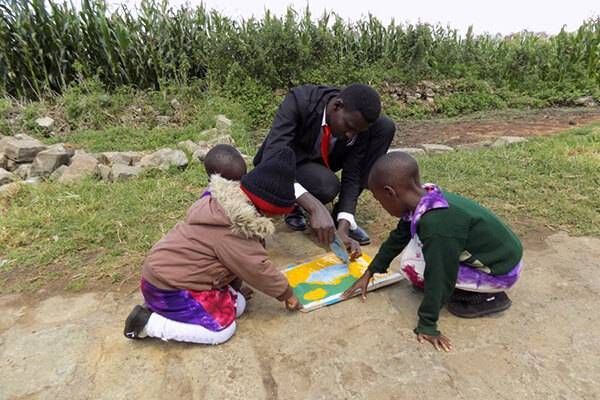
The Corner of Hope school in New Canaan, Kenya is thriving and has become a community center. A second location has opened at a nearby location at the request of the community in Kisima. Corner of Hope has become a model for analysis and replication.
In April, I attended Montessori’s Annual Global Meeting in Delft, The Netherlands, and learned about other programs the Association Montessori Internationale has begun:
One is called Montessori for Dementia, which offers an effective and humane way to treat elders in residential living communities. In this program, caretakers learn how to support elders with dementia to exercise their memory with Montessori materials and cards, to retain their mobility with Montessori’s practical life activities, to find purpose by serving others in daily communal acts such as setting the table to eat a meal together, cleaning their surrounding environments, and caring for plants, themselves and each other.
Another is called Community Rooted Education (CoRE), by the Indaba Institute and AMI. AMI teacher trainers and humanitarian partners have been helping people to serve their own communities by imparting Montessori principles of respect, fostering independence, and restoring dignity and sense of purpose through activity, specifically in severely distressed areas in South Africa.
In Mexico, the Association Montessori Internationale’s EsF through Montessori Mexico has helped transform orphanages, areas where violence has been high, programs for those with disabilities, adolescent communities and state prisons where women, men and children are living. Where they have had little to do and no hope or agency, they now are able to care for themselves, assist each other, build beautiful environments for living and work with Montessori materials for practical life and learning. This movement is rapidly expanding with great enthusiasm.
Another AMI program helping children internationally in orphanages and traumatized communities is called Montessori Sports. When supported with good sportsmanship and positive coaching, sports can serve children’s needs for self-expression, sensory exploration, self-actualization, and offer a way to learn about oneself, learn how to work with others, and to learn how to care for your body for life. In one girl’s orphanage in Africa, the soccer team–coached locally with AMI’s Montessori Sports program–became like a lifeline of support for the girls.
Initiatives in the United States
More locally in the United States, a Montessori organization called Montessori Partners Serving All Children (MPSAC) empowers people to begin Montessori schools in their own communities, honoring–rather than diminishing–their indigenous cultures. This organization is based in the AMI Montessori Training Center of Minnesota.
Spreading the Montessori approach has made a tremendously positive impact on the children and adults in numerous communities around Minneapolis/St. Paul. Specifically, Montessori supports indigenous and immigrant families to continue their culture and language, to celebrate their heritage, and to simultaneously learn about the culture of their surroundings, so they can thrive. Through the Montessori schools these communities have created for themselves, children develop Montessori’s fostered traits of resourcefulness, the ability to focus their attention with confidence, and to collaborate with those around them.
See inspiring videos of people from the Hmong community, Latino community, Shakopee Mdewakanton Sioux community, families living without a permanent home, and those from the American Indian Childcare Center.
A Wholistic Approach for Life
Montessori’s approach in these situations works, because Montessori responds to the child’s call, “Help Me to Help Myself!” and extends it to the adults, as well:
-It values, respects and employs each person’s gifts
-Children (& all humans!) share some basic, universal qualities & needs
-We prepare the best environment
-We model moral behavior, grace and courtesy
-We offer freedom in balance with responsibility
-We observe first, then respond to what we have observed (then repeat this pattern indefinitely)
-Montessori encourages and supports self-agency and empowerment
-Montessori is a wholistic, yet practical approach that can be implemented anywhere
Can you imagine what may happen as these efforts spread to more people? The Montessori approach–to education and to community life–is spreading and being made possible all around the world. It is gradually growing, and it is empowering children and adults to make positive changes inside themselves, and to their surroundings. As families who are growing with Montessori values, YOU are a part of this–something bigger than yourselves. Your children will be making a difference in the world, because they are learning values that are made actionable every day. This realization is a seed that I hope will give you strength and inspiration!
If you are interested in donating or learning more about the initiatives described, please see the websites provided, or give to the
Montessori Global Growth Fund, which supports many of these efforts and more!