If you’ve been at a playground with young children, you’ve probably heard parents imploring their children: “You need to share!” At best, a child will hand over the toy, with a look of confusion or sadness on their face. At worst (and probably more frequently), they will cling even more tightly to the toy, resulting in a tantrum or a battle of the wills. These scenes play out on playgrounds, in sandboxes, and in homes across the world. It’s a natural and well-intentioned impulse on the part of the parents, who want their children to grow up with prosocial tendencies, and an ability to think about others and make friends.
However, it is also a natural and well-intentioned impulse on the part of the child to hang on to their toys. Children don’t consciously have the same long-term goals as their parents, of course, but they are following a strong internal guide, which does ultimately want what’s best for them. A child under the age of six is “selfish” by necessity. In order to grow up to be an adult who is able to think about others and make friends, they must first go through this phase of development, where they will think almost entirely about themselves.
Planes of Development
Dr. Maria Montessori saw development as spanning four distinct planes: 0-6 years, 6-12, 12-18, and 18-24. Not until age 24 is a person’s brain fully developed. At this point they are considered a complete adult. Modern brain research supports Dr. Montessori’s observation, confirming that rapid brain development ends around age 25.
For the purposes of this article, we will only delve deeply into this first plane—a young child, between the ages of 0 and 6 years. This is an inherently and essentially “selfish” plane. During this phase, children are entirely focused on becoming functioning people, who can walk, eat, communicate, and begin to think independently. Just imagine the tremendous changes that take place between a newborn and a six year old! A newborn can barely hold up their head and can only nourish themselves when their food source is placed right next to their mouth. A six-year-old can run, swim, bike, climb a tree, make themselves a sandwich, and tell you what happened last summer.
The acquisitions that occur in the first plane of development are nothing short of miraculous. Their brains and being are focused on this extraordinary work. Given this perspective, the self-absorption of their work and understanding of the world is necessary and understandable. During these years, they aren’t meant to be thinking about others. They are meant to be employing their mental and physical efforts for their own development.
The Montessori Classroom
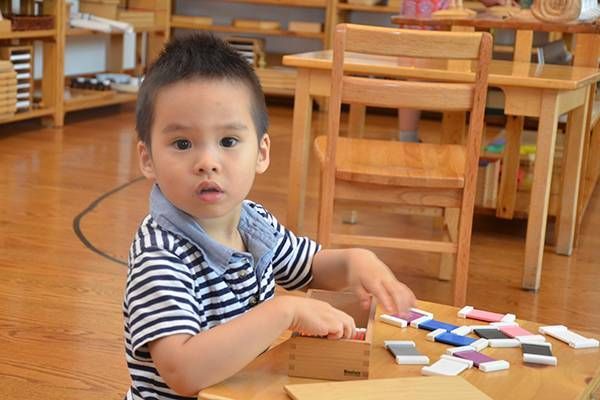
If you walk into a Montessori Young Children’s Community (for 1.5–3-year-olds) or Primary (for 3–6-year-olds), you will see how these individual needs are reflected in the classroom. The tables are designed for one child, the materials themselves are almost all designed for one child to use at a time, and most children will be working quietly and on their own. This is how they learn and develop. They need to be able to concentrate by themselves, and follow their own interests and impulses with the materials. They are not ready to incorporate other’s needs and desires into their work.
Dr. Montessori observed that a child before the age of 6 is a distinct being from a child after the age of 6. A young child needs individual freedom to work and explore with activities, unencumbered from the opinions and agendas of their peers. After the age of 6, they become a much more social being. In the elementary classroom, you will notice that the tables seat four, and most materials are designed for groups of children. At this age, social activity motivates them to work. It is a very different plane from the younger child!
Theory of Mind
Modern research supports Dr. Montessori’s claim. Theory of Mind refers to a person’s ability to understand someone else’s perspective. This includes grasping something as concrete as another person’s visual field, as well as the abstractions of other people’s emotions, desires, and motivations. While Theory of Mind starts in the preschool years, the second order of Theory of Mind does not begin until after the age of 6, when children start to be able to predict what someone else is thinking or feeling, or will think or feel, given a certain set of circumstances. These are very sophisticated abilities!
We do not need to worry or feel alarmed if our young children do not yet grasp their friend’s perspective. They are not hanging onto their toys because they do not want their friends to be happy. They are hanging on to their toys because they want to play, and they are developmentally unable to understand their friend’s point of view. This cannot be forced.
Why Do We Care About Sharing?
It can be tempting to think that we will teach our children to share by asking (or insisting). But perhaps the important question is - Why do I want my child to share? Is it because I want them to learn to think about others? Make friends? Be selfless?
These are all important and useful values for a meaningful life, but taking a moment to consider where a young child is developmentally can help us to understand how to actually support them in their journey towards being a prosocial person with emotional intelligence and a selfless nature.
A child who is resisting sharing isn’t resisting becoming a good adult. They are simply following the natural course of their development. These young years are a time for them to be thinking about their own needs. It is a necessity for them. In fact, demanding that they give away their toys while they are playing with them can have the unintended consequence of them becoming even more possessive with their things, or becoming apathetic, suppressing their positive natural urges for concentration and exploration.
So What Do We Do?
One way to verbalize a socially acceptable way of sharing resources is to state to your child, “You are having your turn. You may use it as long as you like. When you are finished, Amelia would like a turn.” Then inform Amelia, “You may have a turn when Teddy is finished. When it is your turn, you may use it for as long as you like.” This gives children words for how something might be shared between friends, giving them space to utilize the toy, and granting them both respect for their desires. And if a child continues to use the toy until the playtime is over, you can tell their friend, “Next time you will be able to use the toy.” There do not need to be any guarantees today.
If a child is becoming emotional about wanting to use a toy, and fixating upon it, then try to distract them with something else. Sometimes this means that they need to physically move somewhere else. It is natural to feel that the most interesting toy is the toy that is in someone else’s hands! Removing your own emotional charge from the situation can help both children feel calm.
The Caveats
While we believe that a young child is rightly focused on their individual development, and should not be forced to share, it is extremely important to note that this does not mean that they are allowed free reign of any environment. In the classroom, we say that a child’s rights end where another child’s rights begin. This philosophy applies outside of the classroom, too.
Children may not take someone else’s work. They may not disturb, distract, or destroy someone else’s work. They must abide by the routines of the day, and the expectations of their family and community - both for their safety, and for (a reasonable level of) peace and harmony. You are the adult. You are in charge. Other people’s emotions and thoughts matter. Protecting your child’s individual development does not mean they can trample on someone else’s.
Final Thoughts
At this age, not sharing is not a moral issue. It is developmental. Your child is following important and natural urges when they resist giving away their toys. Sharing is a point of arrival. Sharing means that a child feels safe and secure, and that they understand someone else’s perspective. It means they understand how someone else feels and why they want the toy. It means they are motivated to connect with others and want to build and maintain friendships. At best, forcing sharing too early only creates insecurity. At worst, it creates the expectation that you can demand that other people let you play with their toys. Children usually remember and imitate how you treat people more than they remember how you demanded that they treat others!
The journey from “selfishness” to selflessness will not happen overnight. It will not happen in six years either. It is a journey that will take all of childhood and beyond. Keep this goal in mind and consider how you can support this value for your child: Patience, grace, and respect for where they are in their own journey.