“Reading aloud to children is a gift that will last a lifetime.” – Maya Angelou
Days with children are full. They are so full that it is often hard to imagine putting anything else into them! Driving to and from school, time outside, trips to the grocery stores, preparing food, cleaning the house, working all this around a parent’s job—it is challenging to make room in a childhood for everything we value. How can we make sure our children develop an appreciation for learning, curiosity about the world, a sense of morality, a feeling that we treasure special moments together, and more?
There are few activities that allow us to capture a spectrum of values in our experiences with our children, and even fewer that we can do in 10-20 minutes at home.
Reading aloud is one of them.
There are so many important feelings, morals, and messages we impart to our children when we spend regular time reading aloud to them: Books are valuable, learning is important, their parents will make time for them when they need them, asking questions about the world matters, they matter. In addition to this, we can layer our own personal and family values into conversations with them around whatever books we choose. The possibilities are almost endless.
Reading aloud taps into the oral story telling traditions of our ancestors. It is an ancient way of learning and relating to others that our children’s brains are primed to be receptive to. This experience can be a part of your parenting lives from the first days of having a newborn through the end of the elementary years (and later, if your children will tolerate it!). While some elements and recommendations will change throughout their childhood, many will stay the same. This time is a treasured, precious space where hidden seeds will grow.
Why Read Aloud?
Emotional Connection
Taking the time to use your voice to share a story to your child imparts a very clear message: You are loved and I have time for you. While reading can happen at any time, there is something special about choosing a regular moment in the day to set aside for this experience. Often it is before bed, when the day is behind both of you, and you can send your child to their sleeping hours with a feeling of comfort and connection. You can also use this shared time to pause and talk about experiences or ask questions about the day they had. Books are full of opportunities to reflect, and can provide a canvas for helping your child make sense of their days.
While the youngest child may snuggle against the person reading, and the young adolescent may sit across the room from their parent, both feel the full presence of their caregiver in the intimacy of that kind of a moment. Both are able to receive the presence in the way that suits the needs of their age. This presence does not need to be extensive. Even 10 minutes of undivided attention will convey to a child that they matter and will cultivate an important emotional connection that will serve them throughout life.
Values and Morals
Reading aloud offers a distinct opportunity to pause and share reflections. The story provides context and narrative that introduce important topics: love, spirituality, what happens after we die, how we treat others, how we treat our world, and much more. These conversations about values and morals are essential to have with children, but they can feel awkward or end up overlooked in everyday life.
When you are reading to your child at whatever age they are, it is inevitable that these topics will arise. These are moments when you can stop and share a story about something you experienced or ask your child a question about what they think. Or you can tell them how you’ve come to consider a particular value or moral. In this way, the conversation arises naturally against the backdrop of a shared story and allows for an organic discussion where your child comes to learn more about your view of the world.
Raising a Lifelong Reader
The first way that children experience books is through being read aloud to. It is in these precious moments that they fall in love with stories. Reading will enhance their lives for as long as they live, allowing them to continue to learn about the world, to satisfy their curiosity, to step into the minds of others, and to stay in touch with a rapidly changing society. But we cannot force them to become readers through worksheets or forced time with books. If we want them to enjoy it, then we have to make it enjoyable.
By giving your child the experience of shared attention, of interesting stories, and of your time, you make reading joyful. You show them how wonderful books are, how captivating reading is, and how much literature can bring into their lives. While they may take a break from reading for pleasure during their high school and college years, these deep-seated memories will give them a place to return to as they become adults.
Intellectual and Academic Benefits
When we read aloud to children, we expose them to vocabulary and sentence structures that are different from everyday conversations. We also expose them to language that is just beyond what they would be able to comprehend through their own reading. They naturally absorb the possibilities within language, and this enhances both their expressive and receptive abilities, which translates directly into reading and writing throughout their school years and beyond.
A deeper understanding of language will allow them to write more comprehensible and richer papers and stories. Additionally, all subjects involve some degree of listening and reading, whether it is reading information, listening to lectures, or interpreting test questions. By giving your child more exposure to stories that you read aloud, you give them a stronger foundation for auditory processing, as well as supporting their reading abilities.
A recent graduate told us he knows that his academic abilities in high school relate directly to how much time he spent with books as a young child. He is able to quickly grasp concepts in textbooks and lectures, and interpret test questions accurately and efficiently. He believes that this has given him an advantage over his peers who may have been exposed to certain subjects before, but lack the same comprehension experiences and abilities.
Reading aloud also enhances your child’s executive functioning. When they listen to a story, they will retain facts, follow sequences, and predict outcomes. All of this directly supports elements of executive functioning such as working memory, flexibility, and planning and prioritization. To say nothing of the impulse control and sustained attention necessary for sitting and waiting for the story to unfold!
When to Read Aloud
There is no absolute right or wrong time to read aloud to your child. Depending on when you are with your children, and what their schedules are, you may find that there are several opportunities, or you may find that it is hard to fit in at any time! Consider your unique days and look for windows when you can set aside 10 minutes (or more if you have it) for reading.
When this is relatively predictable for your child it will feel like a sacred routine that they can count on. This does not mean that every day has to be exactly the same, or that you cannot add reading aloud when the opportunity arises! But it does mean that it adds to the reverence and security of the experience when it happens at the same time every day.
There is an advantage to fitting reading into the bedtime routine. At the end of a long day, most parents and caregivers are tired. Bedtime can feel like a finish line, when rest, recovery, and preparation for the next day can finally begin. After 6pm, 7pm, 8pm, no one in the family is the best version of themselves! But bedtime is also a special opportunity for connection and reflection. It is a chance for children and adults to share a sacred moment together as they finish their evenings and prepare themselves for the day to come.
Reading aloud to children is a special way to bring meaning to the bedtime routine, and it also provides closure to your children’s days. Often, it is not until the end of the day, when there is nothing left on the schedule, that they will open up and share what they have been thinking or wondering. Working to incorporate reading into this moment will allow these experiences and emotions to unfold naturally.
How to Read Aloud
The Youngest Child: Birth to Age Three
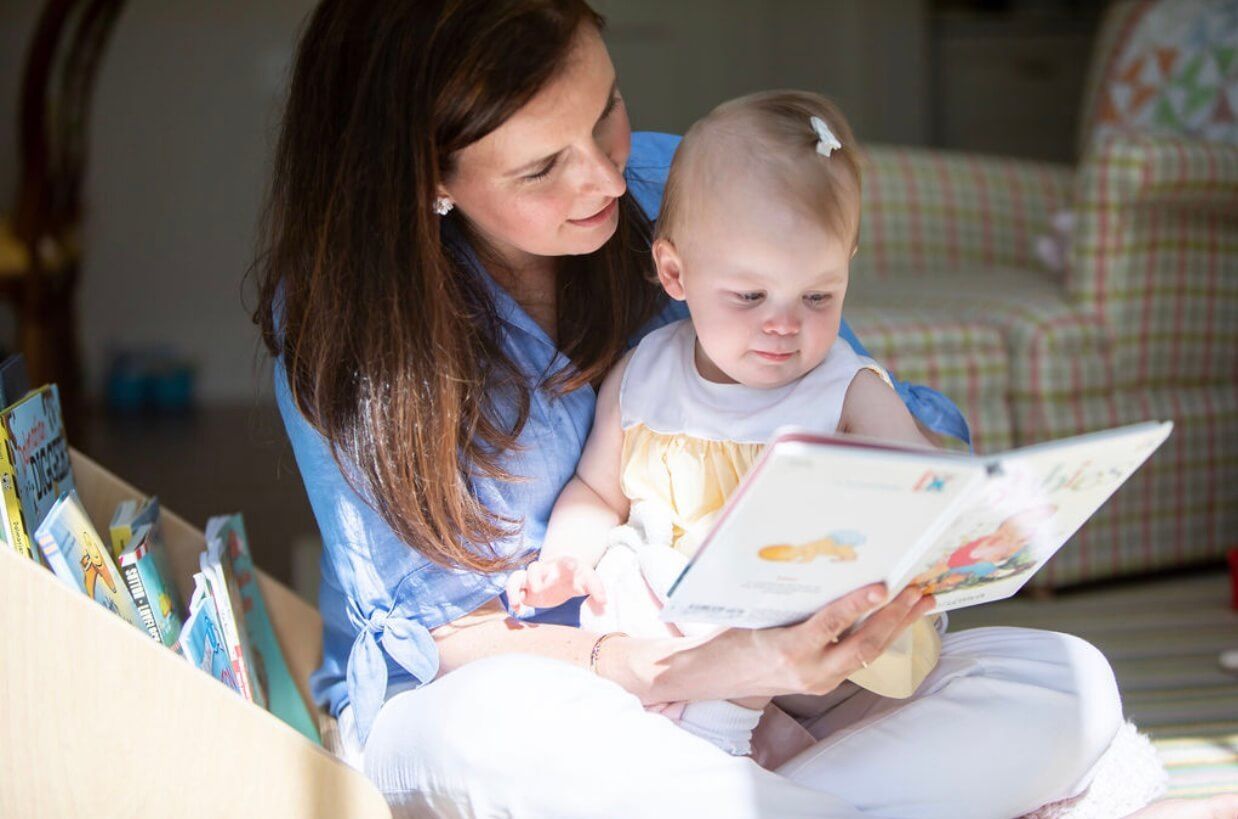
It is never too early to read aloud to your baby! Even a newborn will experience the change in tone, rhythm, and experience of having a parent read a book out loud to them. As they get older and their eyesight and attention develops, they will benefit even more from this time. They’ll look at the pictures, distinguishing light and dark, and seeing colors and shapes. They’ll cultivate their concentration as they study the books. They’ll feel your warm love as they lie in your arms, hearing your voice introducing the world to them.
Once your baby gets close to six to nine months, they’ll start to understand language, and books will become even more interesting. Names will connect to objects and activities, and the words they hear will actually mean something. This is a very exciting time for your child’s development!
After your child is talking, books will become a subject for discussion. Our Young Children’s Community teachers note that many toddlers want to talk about everything in their books! They’ll name what they see, ask questions, and repeat lines of the story that are familiar to them. In fact, if you’ve ever read to a toddler, you’ll probably notice that they love rereading books as much as (if not more than) reading them for the first time. The familiarity allows them to practice their receptive and expressive language, and they will delight in asking the same questions and having the same conversations over and over. They’ll make observations as you read, practicing sharing their thoughts. The discussions that happen around the stories are just as important as the stories themselves. Toddlers are experiencing an explosion into language, and books provide fertile ground for this development.
While your toddler may be exploring their own physical abilities in the world, it is still important that you teach them to respect books. When you are reading to them, you will want to provide expectations for treating them well. If they are grabbing them from your hands, throwing them, ripping at them, or being otherwise destructive, be sure to swiftly and kindly end the activity. You can say, “I can see it’s hard for you to be careful with books right now. Let’s find something else for you to do and you can try again later.” Then, by all means, try again later in the day. Children often reset very quickly. They will likely go through a phase where books are in some danger, but be gentle and persistent in your boundaries and they will come through on the other side.
For the youngest children, reading at a predictable time will help them develop a routine around it. One of our Young Children’s Community teachers shared, “Reading should be like brushing your teeth. Do it every day and at the same time!” In this way, it will become something that they incorporate into their lives and learn to love and expect.
Your Primary Child: 3-6 Years Old
During these years, your child’s ability to sit for stories and pay attention will grow substantially. They are now able to listen for longer periods of time and will refrain from asking constant questions, often able to save their thoughts for the end of a page in a picture book, or a natural stopping point in a chapter book (when they are closer to six). The discussion continues to be an essential part of the reading experience! But now they will let a little more of the story unfold—sometimes with an adult’s encouraging reminders—before interjecting with a desire for conversation around the subject.
Our Primary teachers share that the 3–6-year-old child adores being read to. They will hang on every word, revealing their inner drive to take in information, learn about the world around them, absorb language, and appreciate beauty in any capacity.
One teacher says that her students still love to read the same books over and over again. While it may be tempting to constantly introduce new books, she reminds us:
The children ask for the books from our small classroom library by name. They stroke their covers, and can recall nearly every detail. This kind of attachment to books invites children to rely on them as lifelong companions. They call them back again and again, and I am shocked over and over at how many times a child notices a detail in an illustration that no one has seen before, or, upon the twelfth hearing, a six-year-old pauses and asks what a word means, even though they have heard this story so many times. It is through this kind of connection—a deep and lasting connection—that children associate stories with genuine experience and affection.
A Primary child who is read to regularly and who comes to know the stories intimately will see books as friends. This relationship is a foundation for a lifelong love of reading and learning.
This is a joyful age for introducing the explicit nature of reading. Now they can truly understand the distinct reading times throughout the day. They can request books and begin to understand themes across different stories. While the younger child will appreciate picture books and poems, older children will have developed the attention span and working memory to handle shorter chapter books. But even as you venture into longer stories, remember that the older child will still appreciate the language and illustrations of a beautiful picture book.
Enjoy your read aloud time with your Primary child, incorporating into whatever time of the day is most natural for you. Continue to engage with questions and conversations, while also encouraging them to wait for natural pauses to have these discussions. There is a great deal of change that will happen for your child over the years, and your read aloud experience can reflect this growth!
The Elementary Child: 6-12 Years Old
The Elementary child is in the heart of their read aloud years! At this age, they are capable of sitting and listening for long periods of time. They thoroughly enjoy your time and company. They are curious and eager to learn, and they will make connections from the books you read to them and the world they are noticing outside of their home. This budding awareness means that the discussions you have while reading will become even more complicated and interesting.
You may find that these are some of the most exciting years for reading aloud to your child. There are so many incredible books! It is especially important at this age that you are choosing books that are beyond what they can read for themselves and that offer them a wide variety of stories from cultures, times, and places. This is a wonderful age for selecting books that offer archaic language or dialect or that expand vocabulary and turns of phrase in interesting ways. Take the time as you are reading to discuss unfamiliar words and idioms that come up. Slow down at complicated sentences to make sure your child understands.
Elementary children are deeply interested in morality. Reading aloud offers many opportunities for deep and meaningful conversations about their developing sense of right and wrong. You can pause as you read to highlight decisions that characters are making, and you can invite your child’s thoughts on the morality embedded in the particular stories.
Our Elementary teachers shared some words of wisdom for these reading years: It is important not to choose early readers for read aloud time. Those books are best suited for the children to read to themselves. Similarly, do not use this time to ask your newly reading child to read to you. This changes the nature of the experience into work for them. While occasionally a struggling reader may need practice at home with a parent, that should be a separate activity.
Avoid letting your child read ahead, or reading a book aloud that your child is already reading. For the read aloud experience to be natural, the two of you should be experiencing the story together. You are both on the same journey with the same narrative. This is one of the reasons audiobooks are not replacements for reading aloud. It is not a shared experience, and there is not a real human as a guide through the story.
At this age, when it seems like books are full of opportunities for learning moments, you also want to make sure that your conversations are fully balanced by simply reading the story. If your child starts to feel that every read aloud session is just a time for them to hear a life lesson from you, they may stop enjoying it!
Finally, keep in mind that in order for them to enjoy it, it needs to be enjoyable. Give explanations to the story as you read along if your child seems lost. Don’t quiz them on the book. It’s okay for them not to understand everything. Stay in tune with how your child is feeling and find ways to keep this time special and meaningful. If it’s not going well, you can take a break, but come back to it. You may find that it helps to read by the fireplace, change the location, make a tiny cup of tea, or read a short story. Reading is joyful, and there are so many ways to keep it joyful for you and your child!
The Adolescent: 12-15 Years Old
Once your child enters adolescence, you may find that they resist the read aloud time again! They may feel independent and want to establish their separation from their parents by reading books to themselves and shortening their bedtime routine with you. They are often busier and going to bed later, and making the time is more challenging for everyone. But this is still an important time to share with your child for as long as you can encourage it. While you want to avoid forcing something on them that will negatively impact your relationship, it is worth exhausting your options in order to maintain it as some aspect of your routine with them.
You may find that they enjoy (or at least tolerate!) being read to aloud when they straighten their room at the end of the day, or when they are preparing for the following morning. You may also find that they prefer to hear longer, more complicated books, or, alternatively, short stories or articles. This is an age where you can specifically and explicitly choose stories or articles that address topics you want to discuss as they enter their teen years. Making your reasoning clear invites them into the conversation with respect and dignity. Memoirs and biographies are appealing at this age, as it is a time when young adults are deciding who and how they want to be in the world. Stories with large moral questions that are multi-faceted and complex engage their expanding sense of right and wrong as they move from the black and white thinking of their elementary years. Additionally, stories about adventure and risk appeal to their desire to seek boundaries and test their limits.
Changing the reading that you choose can give your child the sense that you are honoring their older age and acknowledging the ways that they have changed as they enter adolescence.
Even if you find that it is hard to manage reading every night, there is still value in incorporating it a few nights a week or whenever you can. Your children grow and change very quickly at this age, but they still need you as guides and sources of knowledge and comfort during their teen years. Setting aside the time to connect with them will always be worth it.
What to Read Aloud
At all ages, consider books that you will enjoy reading aloud. Your love of literature will be contagious! Likewise, beware of books that you may enjoy but you know your child absolutely will not. It is important to encourage them out of their comfort zone and expose them to stories they might not choose on their own, but you want them to enjoy the experience too. If they are bored or completely uninterested, then it is not the right book for that time.
Children love books that are full of the familiar, but they also appreciate books that expose them to different cultures, people, and areas of the world. Choose books that provide each of these experiences—perhaps some about children who live in neighborhoods just like theirs, and also stories about people who live lives that they can only imagine. This becomes especially important as your child grows. Gaining a deeper understanding of how other people live and think and the challenges they face will cultivate their empathy, social skills, and compassion.
For similar reasons, be cautious of series of books. While it can be fun to dip in and out of them, you want to make sure your child is exploring and experiencing new stories, new authors, and new worlds. A series is an easy way to end up in an intellectual and creative rut for the sake of comfort and familiarity!
Finally, as much as possible, choose books that are beautiful. Even the simplest books can be full of beauty—the language, the illustrations, and the stories. Children build themselves with the world they are exposed to. Your child’s mind is incredibly elastic and impressionable. When you choose books that nourish them with rich language and ideas, you are nourishing their intellect, creativity, and emotional life. Beautiful books will become part of the foundation they keep for the rest of their lives.
Final Thoughts
As Maya Angelou observed, reading aloud to your children is a gift that will last them their whole lives. This experience offers important social, emotional, creative, and intellectual gifts. It gives your children an academic foundation and it gives them the essential belief that they matter to you. It gives them opportunities to ask pressing questions and hear about your life and values. It is a simple, often brief, activity, with effects that will last for days, months, and even years. The time you take to offer your children this gift will become a part of who they are when they no longer live with you, and will give them the foundation for being who they want to be in the world.
Special thanks to the teachers who generously shared their time and wisdom on this topic.
Book Recommendations for Reading Aloud
Young Children’s Community
● Goodnight Moon, The Big Red Barn, and The Runaway Bunny, by Margaret Wise Brown (Author)
● The Very Busy Spider, by Eric Carle (Author and Illustrator)
● Brown Bear, Brown Bear, What Do You See, by Bill Martin, Jr., (Author) and Eric Carle (Illustrator)
● The Lion and the Mouse, by Jerry Pinkney*
● Oh, Dear, Look What I Got, by Michael Rosen (Author) and Helen Oxenbury (Illustrator)
*The children love the repetition in this book and chime in when we get to the refrain!
● A Ball for Daisy, by Chris Raschka*
*Picture books without words allow you to create a slightly different story every time. You can focus on different aspects of the illustrations each time you read it.
Illustrated song books:
● Hush, Little Baby, by Marla Frazee
● Inch by Inch, by David Mallet (Author) and Ora Eitan (Illustrator)
● What a Wonderful World, by Bob Thiele (Author) and George David Weiss (Author) and Tim Hopgood (Illustrator); (As sung by Louis Armstrong)
Primary
● The Lady With Two Different Socks, by Courtney Bednyak
● Catch That Chicken, by Atinuke and Angela Brooksbank
● Goodnight Moon, The Big Red Barn, and The Runaway Bunny, by Margaret Wise Brown (Author)
● Just Ducks!, by Nicola Davies
● Red Shoes, by Karen English (Author) and Ebony Glenn (Illustrator)
● Thank You, Omu, by Oge Mora
● Last Stop on Market Street, by Matt de la Pena (Author) and Christian Robinson (Illustrator)
● Three Little Wolves and the Big Bad Pig, by Eugene Trivizas (Author) and Helen Oxenbury (Illustrator)
● Farmer Boy, by Laura Ingalls Wilder (Author)
For older Primary students:
● Books about the national parks by Kate Messner
● Books about the nature of the Midwest by Dianna Hutts Aston
Lower Elementary
● Rikki-Tikki-Tavi, by Rudyard Kipling
● Rabbit Hill, by Robert Lawson
● The Chronicles of Narnia, by C.S. Lewis
● Where the Mountain Meets the Moon, by Grace Lin
● Betsy, Tacy, and Tib, by Maud Hart Lovelace
● Mrs. Frisby and the Rats of NIMH, by Robert C. O’Brien
● Island of the Blue Dolphins, by Scott O’Dell
● All-of-a-Kind Family, by Sydney Taylor
● Banner in the Sky, by James Ramsey Ullman
● The Boxcar Children series, by Gertrude Chandler Warner (*note: Warner wrote the first nineteen in the series)
● Trumpet of the Swan, by E.B. White
● Childhood of Famous Americans, by various authors
● Patricia Polacco’s books
Upper Elementary
● Anything, by Sharon Creech
● The Evolution of Calpurnia Tate, by Jacqueline Kelly
● Greenglass House, by Kate Milford
● Wonder, by R. J. Palacio
● Hatchet, by Gary Paulsen
● The Westing Game, by Ellen Raskin
● Echo, by Pam Munoz Ryan
● Good Masters! Sweet Ladies!: Voices from a Medieval Village, by Laura Amy Schlitz
● Heidi, by Johanna Spyri
● The Mysterious Benedict Society, by Trenton Lee Stewart
● Anne of Green Gables (series), by L.M. Montgomery
● Moon Over Manifest, by Clare Vanderpool
● Brown Girl Dreaming, by Jacqueline Woodson
Secondary Level
● Watership Down, by Richard Adams
● The Three Musketeers, by Alexandre Dumas
● Prairie Fires, by Caroline Fraser
● The Wind in the Willows, by Kenneth Grahame
● The Haunting of Hill House, by Shirley Jackson
● The Yearling, by Marjorie Kinnan Rawlings
● The Cruelest Miles, by Gay Salisbury
● Treasure Island, by Robert Louis Stevenson
● The War of the Worlds, by H.G. Wells