Why Are Montessori’s Sensorial Materials Important for Children? Great question! We all recognize those beautiful wooden prisms and the pink tower of cubes as being Montessori’s distinct materials for children’s development. The glossy red rods and the blocks with rows of tiny wooden knobs are intriguing. They seem to call out to be touched and handled. But there is so much more to this special set of 25 Sensorial Materials than their beauty; they are instrumental to children’s individualized educations, as students and as human beings.
The Sensitive Periods
There are distinct periods of human development through which every young child passes by the time they are five years old. These sensitive periods make children especially attuned to a particular physical sense, and to concentrate on it almost to the exclusion of all others. This happens for every child but can be hard to recognize if adults are not paying attention to their children’s behaviors or providing opportunities for children to explore these aspects of their surroundings.
For a young child, the world is a jumbled mass of impressions. He or she arrives on Earth with no knowledge, but with a gift of five senses—touch, taste, smell, hearing and sight—and the urge to explore through them. To help each child make sense of this world, education must offer a way to organize and label the chaos that they encounter every day. The orderly Sensorial Materials do just this.
As a child learns from working with Montessori’s Sensorial Materials in the classroom, he or she goes back out into the world and delights in naming qualities and recognizing forms all around them; it is as if she sees color for the first time now that she knows what it is, what it is called, and where it belongs in the order of things. Imagine what a joy this revelation is for a child!
The Sensorial Materials are foundational to Montessori education. Dr. Montessori’s journey as an educator began, in fact, with sensorial materials. Maria Montessori’s first professional task as a physician was to attend to the physical and mental wellbeing of young children in a psychiatric asylum. She learned so much about human development by working with these children with issues ranging from physical disabilities to psychological disturbances. Unfortunately, in the early 1900s in Europe, it was customary to segregate such individuals from society and lock them into a room with nothing to do. Montessori’s heart went out to these children. The first thing she noticed by observing them was the intense need for sensorial stimulation to feed not only their bodies, but their minds. Nature drives us to touch and handle objects from early ages in an effort to understand the world and develop the connections between our bodies and our minds—between movement and thinking. In this way, human beings identify and name the qualities of the world—color, scents, sounds, etc. Everything has a relationship to all else, a place in a set of qualities, and a name we attach to it.
Dr. Montessori realized, “The child is by his nature an avid explorer of his surroundings because he has not yet had the times or means of knowing them precisely” (The Discovery of the Child). She recognized that we can help children to acquire this knowledge in an organized fashion. As Dr. Montessori experimented systematically in showing children her first materials, she found that they were drawn to them and wanted to repeat their activities until they mastered each one. The children, she realized, were educating themselves through their use of these precise materials. They were serving a fervent need.
By combining her discoveries with studies of other doctors’ and scientists’ work, Maria Montessori designed and experimented with sensorial materials that would inform children about the qualities of the real world. To this day, her Sensorial Materials brilliantly support children to explore and learn the language for identifying differentiating qualities of color, temperature, size, weight, length, height, and spatial equalities. They enable children to train and practice their hand-eye coordination, decision making ability, discernment between details, and organization of information. The sensorial materials help children to build their unique, organized minds.
Which Ones Are The Sensorial Materials and What Does Each Address?
Below is a basic list of Dr. Montessori’s Sensorial Materials and the qualities children explore with them, which you will find in any AMI-accredited Primary classroom for children ages 3 to 6 years old.
Form and Dimension
Form and dimension are explored in the visual sense with:
The Solid Cylinders
The Brown Stair
The Pink Tower
The Red Rods
The Knobless Cylinders
Colors
Colors are distinguished, developing the chromatic sense in:
3 boxes of Color Tablets
Discrimination of Form
The Geometry Cabinet
The Botany Cabinet
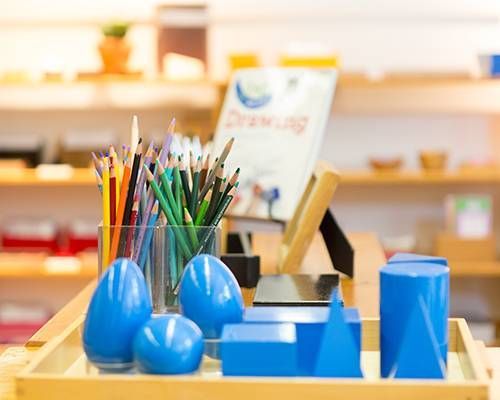
The Geometric Solids
Constructive Triangles
Binomial and Trinomial Cubes
Square of Pythagoras (also called The Decanomial)
Superimposed Geometric Figures
The Tactile Sense
Touch Boards
Touch Tablets
Fabrics
Baric Tablets
Thermic Bottles
Thermic Tablets
The Auditory Sense
Speaking and Singing with the human voice
Sound Cylinders
The Bells

The Olfactory and Gustatory Senses
The Smelling Jars
The Tasting Jars
The Stereognostic Sense
The senses all come into play when we explore with the stereognostic sense, which refers to the all-around familiarity and knowledge of an object (stereo=all around; gnostic=knowledge). We invite children to feel an object with their hands and determine what it is by discriminating, through their senses, the weight, temperature, surface, and shape. The materials specifically designed for this are:
The Geometric Solids
The Mystery Bag (of various objects)
Most of the sensorial materials can also be explored in this stereognostic manner, often while using a blindfold if the child chooses to wear one, following the introduction of this style of exploration with the Geometric Solids and the Mystery Bag.
Final Thoughts
There are many purposes to Montessori’s set of Sensorial Materials, but the main ones are to refine one’s senses and acquire the ability to recognize, appreciate, connect, label, and describe the qualities one encounters out in the world. This self-education offers children a sophisticated experience of living.
Sensorial Materials Part II to follow!