
Articles
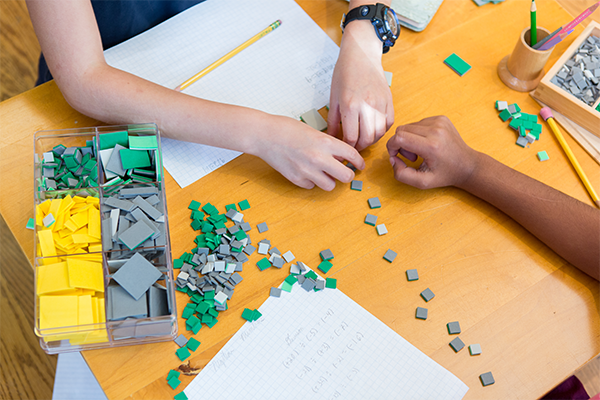
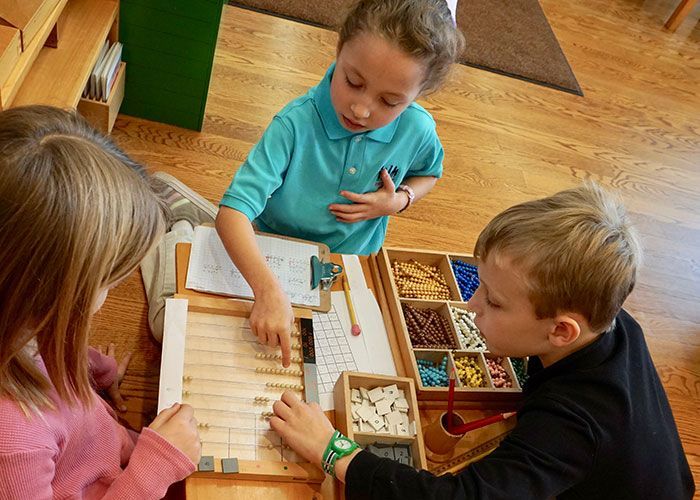
Montessori vs. The Conventional Model Anyone who has seen a Montessori school understands that it is fundamentally, startlingly different from a conventional education. While students complete their experience at a Montessori school with similar academic abilities as their counterparts in conventional schools, they go about these acquisitions in a completely different way. A Montessori education is, at its core, a child-centered education. This does not mean that children do whatever they want while they are at school. It means that the approach assumes that the child is an active agent in their educational experience, and that they will construct themselves, given the right structure, guidance, and materials in their environment. The formal schooling that is familiar to American culture today originated hundreds of years ago in monasteries. It further solidified its methodology in the late 1800s and early 1900s when industrialization was introduced to the United States, and schools began to depend upon the “factory model” to produce good workers en masse. Since then, study after study in the field of child development has confirmed that this is not the ideal way for children to learn. Yet, when universities, schools, and lawmakers propose improvements to the educational system, they simply add on to a system that is already not working well, by (for example) increasing testing, making rewards even more compelling, and dividing children into even more pronounced groups by ability and age. Where Do We Go From Here? In Dr. Angeline Lillard’s new article, Why the time is ripe for an education revolution , which was published in Frontiers in Developmental Psychology, she argues that this is a cultural moment when the educational system ready for a paradigm shift - one that would move away from a fundamentally teacher-text-centered (TTC) base and towards child-environment-interplay (CEI), which recognizes that “A child develops into an adult by constructing an elaborate representation of self and world, and learning to interact with and exercise agency in that world. This development occurs in a dynamical, non-linear fashion across childhood” (Lillard, 2). The CEI model is supported by modern research and is an ideal fit with Montessori. Lillard supports her argument by comparing today’s cultural climate to the factors at play in the 1500s when astronomers moved away from an earth-centered view of the universe to a helio-centered view of the universe. While there were recognized flaws in the previous understanding of the universe, it wasn’t until certain cultural elements were present in the 1500s that civilization as a whole was ready to transition to the realization that the sun was at the center of the universe. Just as in education, simply knowing that something isn’t working often isn’t enough. Human nature is compelled to continue to make adjustments and explanations for what already exists rather than leaping to a brand new perspective. As it was 500 years ago, Lillard believes that the world is ready to make the leap to a new approach to schools. The time is ripe for an education revolution. And Montessori is ready for it.
Forest Bluff School in Lake Bluff, IL, shares a Montessori perspective on screen time and its impact on child development.

Forest Bluff School in Lake Bluff, IL, offers Montessori insights for parents on managing technology and social media for teens.