The Montessori Young Children’s Community
Paula Lillard Preschlack • August 26, 2019

Why Go to School, Little One?


Sometimes people are surprised to hear that children can begin attending Forest Bluff School when they are only 18 months old. You may wonder, “What in the world can a one-and-a-half-year-old do in a school?” And yet, we know from research and observations that the first years of life are by far the most rapidly formative, important years of development, physically and psychologically. Dr. Montessori recognized that providing a special environment, designed to help young children in specific ways, makes sense. Once you see with your own eyes what the littlest children do in a prepared Montessori environment, skepticism evolves into awe.


In a Young Children’s Community of 18-month to 3-year-olds, we see children removing their own coats and reaching up to hang them on hooks at eye level in their cubbies, choosing work from the shelves that come to their waist height, and carrying materials to small tables or rugs where they decide to do their “work.” Once there, young children focus their attention on tasks that interest them greatly, using their hands, thinking through the steps, experimenting with the materials, and communicating with their teacher and fellow classmates.
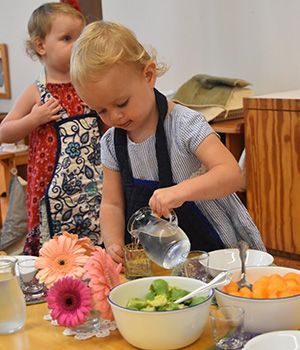

A little girl is pouring water into a bowl of vegetables.

At a time in life when they are intensely concentrating on developing body control, thought processes, and the abilities to communicate their emotions and thoughts, very young children benefit tremendously from being in a learning environment that provides activities that perfectly meet their developmental characteristics and needs. Manipulative materials provide opportunities to develop hand-eye coordination. Language materials give ample experience with new vocabulary and pronunciation aided by the adults in the room. Practical Life activities help children form understandings of sequences, muscle control, memory, and logical thinking. The roots of music, artistic expression, biology, counting, measuring, and more are presented in a rich learning environment that young children feel safe to explore. Most important perhaps, is the confidence that young children build in their daily successes and the awareness of others in a community with an understanding of their own role within it. This confidence gives children the springboard to learn and develop at nature’s pace, without being held back from lack of exposure or by environments that do not match their developmental characteristics and needs.


At Home


Being at home with their families is invaluable for very young children, too. Most parents find that when their 18-month-old children spend three hours at school, there is still plenty of time to connect at home as well, even when they attend a Montessori program five mornings a week. The continuity and regular morning schedule allows children to calmly settle into a routine that makes sense to them. While parents have their time to get things done without children in tow, young children get to go do their “work” at the same time. At lunchtime when they are reunited, parents can give their full attention to their children and still have several hours together after nap time as well.


If parents could provide all the opportunities and atmosphere for optimal development in our homes, a Young Children’s Community would not be necessary. But realistically, with our attention divided, the phone and door bell ringing, emails coming in, and so many complex demands in our home lives these days, it is more challenging for young children to develop the deeper focus and to access activities that truly help them in their development.


A Special Learning Environment
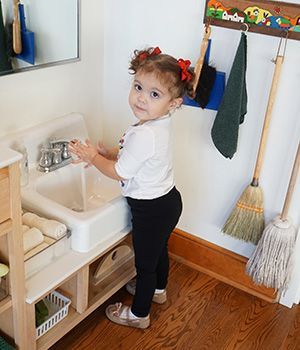

A little girl is washing her hands in a bathroom sink

Bringing young children to a safe place where they have a peaceful atmosphere, respect, and attentiveness from trained teachers, and where they can move at their own pace as they become masters of their own bodies and minds, is a gift. The Young Children’s Community, with useful but tiny objects and perfectly-sized furniture, functioning refrigerator, sink, toilet, and toaster oven, all down at their level, empowers young children to boldly learn how to take care of themselves and contribute to others. Because Montessori teachers are trained to recognize developmental stages and needs, they are uniquely poised to help children when and where it matters most. The moments for language development, understanding processes and sequences for logical thinking, and setting the foundation for mathematical and higher thinking are attended to.


Furthermore, as human beings, we are designed to connect with others. Our young children have this need from the beginning of life. Their social development, self-awareness, and communication skills need attention to develop well in the early years. So, come to school, Little Ones! The Montessori Young Children’s Community is here for you at Forest Bluff.


Listen to Building a Foundation for Life to learn more about how the Young Children’s Community supports the development of children under the age of three.
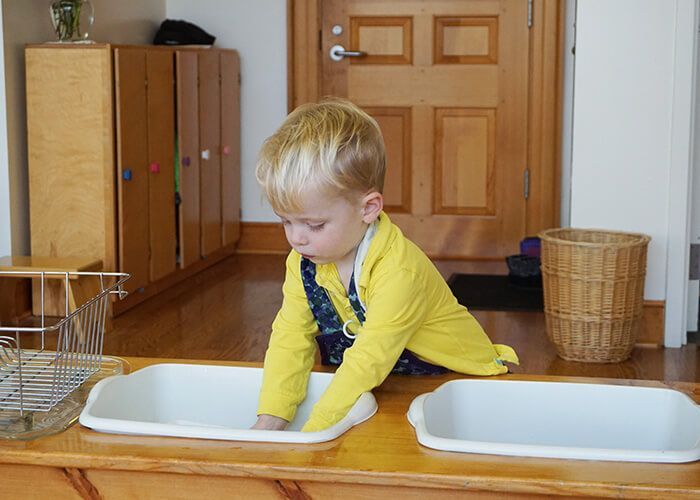
A young boy is washing in a white sink
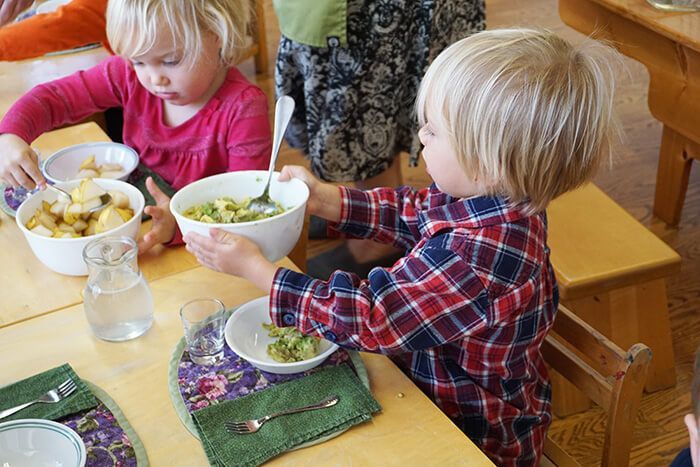
A boy and a girl are sitting at a table eating from bowls.
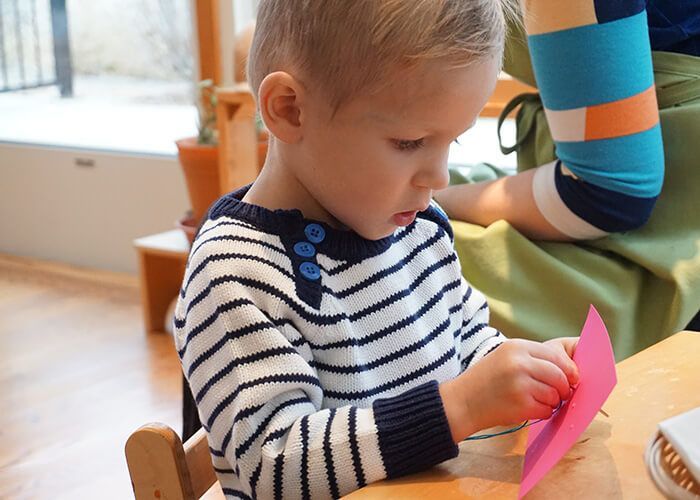
A little boy is sitting at a table sewing with a piece of paper.
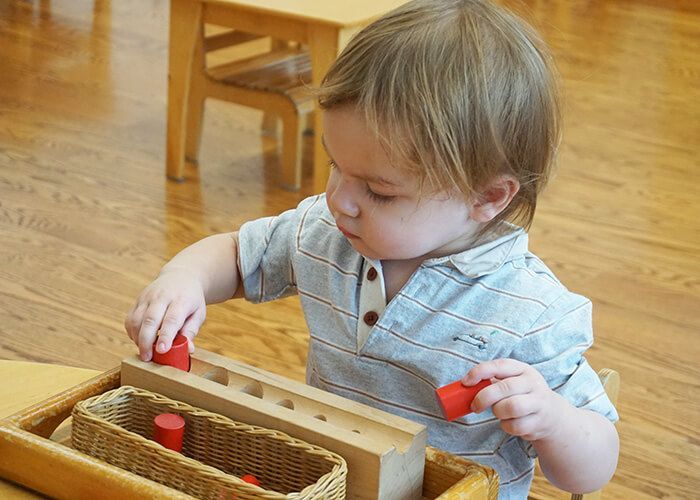
A young boy is playing with a wooden toy.
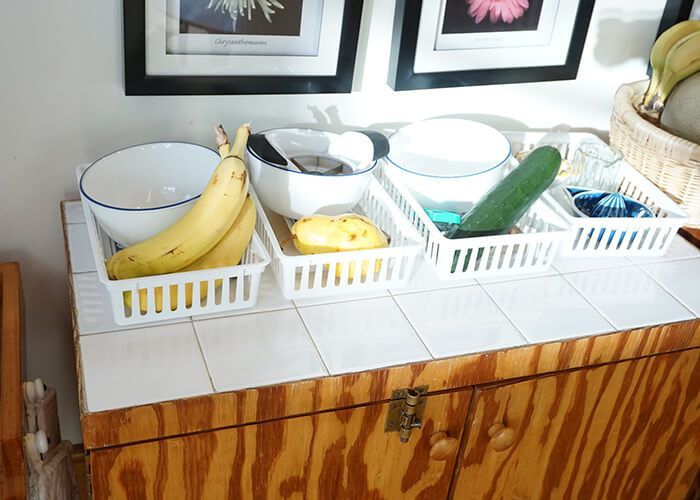
A table with a bunch of bowls and baskets on it
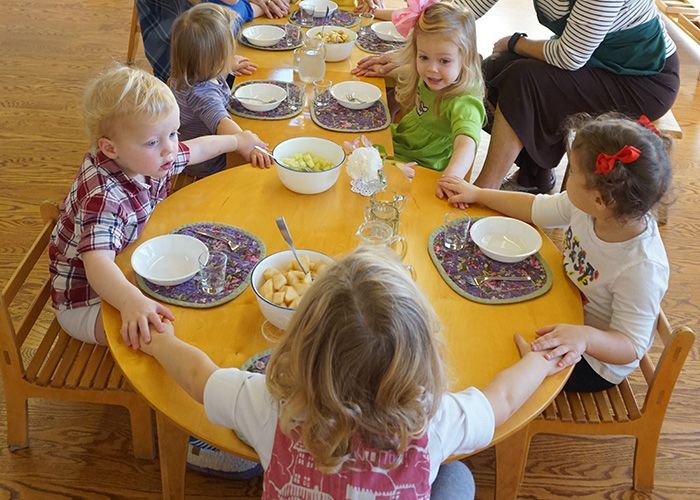
A group of children are sitting around a table with bowls of food.
A teacher and Montessori student at Forest Bluff School in Lake Bluff, IL, shake hands.
By Alice Davidson with contributions by Margaret J. Kelley February 25, 2026
In Montessori education, we view each child as inherently capable of developing a strong sense of right and wrong. A child’s moral compass is not something we impose upon them—it is something that grows within, guided by experiences, reflection, and consistent modeling from the adults in their lives. For that moral sense to take root, children must be allowed to experience accountability for their actions. When parents shield their children from consequences or defend behavior they know is wrong, they unintentionally undermine that process, creating confusion and instability in the child’s understanding of truth, fairness, and responsibility. Many parents defend their children out of love and protectiveness. They wish to spare their child from discomfort, embarrassment, or the feeling of failure. Yet this kind of protection, though well-intentioned, teaches the opposite of what true love demands. One of the tenets of Montessori is to put children in contact with the real world in age-appropriate ways, trusting that they have the inner capabilities to grow and adapt when they have real experiences. When parents constantly justify, minimize, or excuse poor behavior, a child misses an opportunity for feedback; they learn that honesty is flexible and that integrity can be negotiated. This erodes their moral foundation and leaves them uncertain about what is right—not because they cannot feel it, but because the adults they trust most are contradicting that inner voice. In Montessori, children learn to do work and make decisions based on intrinsic, not extrinsic motivation. We trust that they have goodness inside of them, and while they absolutely need guardrails and guidelines, we can best serve them by teaching them to distinguish between their internal drives, and to take action in accordance with their conscience. Children are perceptive. They often know when they have done something wrong—whether they spoke unkindly, acted selfishly, or disrespected another. When their parents immediately defend them or blame others, the child experiences an internal conflict. On one hand, their conscience tells them they made a mistake; on the other, the parent’s response tells them they are in the right. Over time, this mismatch between inner truth and external validation creates confusion. The child begins to question their own moral instincts and may even learn to ignore the pangs of conscience altogether, relying instead on external approval to define what is acceptable. This is one of the greatest harms of over-defending a child: it separates them from their natural moral compass. When children are consistently told they are right—even when they know they are not—they start to equate love with being defended rather than being guided. They may learn that relationships are maintained through justification and blame-shifting instead of honesty and repair. Later in life, these patterns can manifest as difficulty accepting feedback, resistance to authority, or an inability to take responsibility in personal and professional relationships. In Montessori classrooms, we see accountability as a cornerstone of growth. When a child makes a mistake—perhaps they take another’s materials without asking or speak rudely to a classmate—we respond not with shame, but with calm guidance. We help the child reflect: What happened? How did this affect others? What can you do to make it right? This process nurtures empathy and clarity. It helps children see that they can correct their mistakes, that doing wrong does not make them bad, and that making amends restores both harmony and self-respect. Accepting that your child can be wrong is not a sign of parental failure—it is a sign of courage and wisdom. When you model accountability yourself, your child learns that truth is not something to be feared. They see that mistakes are part of being human, and that integrity means facing them with grace. Ultimately, allowing your child to experience and accept the consequences of their behavior builds confidence, empathy, and moral clarity. Shielding them from accountability may protect their feelings in the short term, but it confuses their conscience and weakens their inner sense of right and wrong. By guiding them lovingly toward truth and responsibility, you empower them to grow into kind, honest, and self-aware individuals—qualities that form the true foundation of a moral life.
A Montessori student at Forest Bluff School uses grammar symbols and color-coded tiles
By Margaret J. Kelley January 24, 2026
Discover how Forest Bluff School on Chicago's North Shore uses Montessori symbols to teach grammar, making language arts engaging for Primary and Elementary students.