The Montessori Potential: A New Book for Parents, Educators, and Policymakers
Margaret J. Kelley • February 5, 2023

Our former Head of School Paula Lillard Preschlack says with a laugh that her older sister Lynn Lillard Jessen convinced her to begin her Montessori journey by enticing her with bowls of ice cream and asking her, “What else are you going to do?!”


More than twenty-five years later, we can all be grateful that Paula didn’t choose something else to do! Paula spent almost three decades taking three Montessori trainings, teaching at the Primary and Elementary age level, leading Forest Bluff School as a Head of School, raising her own two children in a Montessori home, working with parents, reading countless books on development and Maria Montessori, and continuing her own education through conferences and conversation with other educational, developmental, and Montessori experts. She also continued to write and give talks in order to share this information, as well as her knowledge and observations, with this special community.


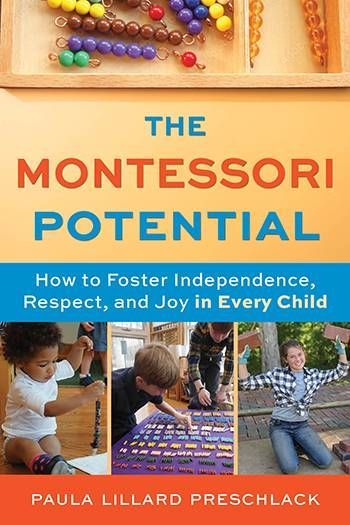
After twenty-five years at Forest Bluff, Paula has moved to the next chapter of her life, writing a book on what she learned about Montessori in action. On February 7, her book “The Montessori Potential: How to Foster Independence, Respect, and Joy in Every Child” will be released to the public! This book is a culmination of her work so far, not only sharing the theory of Montessori, but offering lively anecdotes and engaging conversation that bring the theory to life.


Her book serves as more than just an explanation of the Montessori curriculum. In it, she describes how it actually works, with examples from real classrooms, and what triumphs and struggles schools face every day as they implement this approach. Her insights into Montessori’s practical application are invaluable. It is a call to action for parents, teachers, administrators, policy makers, and all interested community members. Paula shares, “This book is for educators, reformers, concerned citizens, and parents, who want to learn how to recognize authentic Montessori education and to learn how—exactly—the approach works so well for children.”


Paula’s book walks the reader through the essentials of the Montessori framework, what an ideal Montessori school looks like, why authentic Montessori matters and what challenges it faces, how Montessori is integrated into public schools, and what Montessori looks like for parents at home. Her entertaining stories about real life students and teachers make these important points accessible and memorable.


Order Paula’s book anywhere where you buy books, and join her for a virtual book launch on February 7 and for a book signing at Gorton Community Center with Lake Forest Book Store in Lake Forest, IL, on April 28 from 5-7pm. Check her website for virtual and in-person speaking events across the country this year, or contact her to speak at your school or community!


Paula’s book plays an important role in bringing the potential of a Montessori education to the greater world. Nora Flood, the Education Lead at Wend Collective, writes, “This is the most comprehensive book I have read that illustrates the history of, framework for, and power of the Montessori approach. Preschlack’s writing has helped me understand, and in turn articulate, why every child deserves a Montessori education!”


Michael G. Thompson, coauthor of Raising Cain and The Pressured Child, writes, "In her passionate and beautifully written new book, Paula Lillard Preschlack explores not only the potential of the Montessori approach but also the potential of children to grow into fully engaged and joyous learners. In a time when we see children as fragile and in constant need of our anxious supervision, Preschlack sees them as independent, adaptable, and resilient. Educators and parents and politicians need to read The Montessori Potential to remind themselves of what children can do if we create learning environments for them that unlock their strengths."


Links


Order your book from The Lake Forest Book Store or Amazon


Virtual book launch


Gorton book event (sign up for her newsletter for a free invitation)


Interview with Julia Volkman of Maitri Learning


Paula’s website


Paula’s Soundcloud site for a variety of talks


Newsletter for educators

A young child outside on a sunny day using a watering can to water potted herbs and flowers
By Margaret J. Kelley April 20, 2026
Forest Bluff School in Lake Bluff, IL, explores how the Montessori philosophy helps families trade "crippling empathy" and anxiety for a productive, grounded optimism.
A teacher and Montessori student at Forest Bluff School in Lake Bluff, IL, shake hands.
By Alice Davidson with contributions by Margaret J. Kelley February 25, 2026
In Montessori education, we view each child as inherently capable of developing a strong sense of right and wrong. A child’s moral compass is not something we impose upon them—it is something that grows within, guided by experiences, reflection, and consistent modeling from the adults in their lives. For that moral sense to take root, children must be allowed to experience accountability for their actions. When parents shield their children from consequences or defend behavior they know is wrong, they unintentionally undermine that process, creating confusion and instability in the child’s understanding of truth, fairness, and responsibility. Many parents defend their children out of love and protectiveness. They wish to spare their child from discomfort, embarrassment, or the feeling of failure. Yet this kind of protection, though well-intentioned, teaches the opposite of what true love demands. One of the tenets of Montessori is to put children in contact with the real world in age-appropriate ways, trusting that they have the inner capabilities to grow and adapt when they have real experiences. When parents constantly justify, minimize, or excuse poor behavior, a child misses an opportunity for feedback; they learn that honesty is flexible and that integrity can be negotiated. This erodes their moral foundation and leaves them uncertain about what is right—not because they cannot feel it, but because the adults they trust most are contradicting that inner voice. In Montessori, children learn to do work and make decisions based on intrinsic, not extrinsic motivation. We trust that they have goodness inside of them, and while they absolutely need guardrails and guidelines, we can best serve them by teaching them to distinguish between their internal drives, and to take action in accordance with their conscience. Children are perceptive. They often know when they have done something wrong—whether they spoke unkindly, acted selfishly, or disrespected another. When their parents immediately defend them or blame others, the child experiences an internal conflict. On one hand, their conscience tells them they made a mistake; on the other, the parent’s response tells them they are in the right. Over time, this mismatch between inner truth and external validation creates confusion. The child begins to question their own moral instincts and may even learn to ignore the pangs of conscience altogether, relying instead on external approval to define what is acceptable. This is one of the greatest harms of over-defending a child: it separates them from their natural moral compass. When children are consistently told they are right—even when they know they are not—they start to equate love with being defended rather than being guided. They may learn that relationships are maintained through justification and blame-shifting instead of honesty and repair. Later in life, these patterns can manifest as difficulty accepting feedback, resistance to authority, or an inability to take responsibility in personal and professional relationships. In Montessori classrooms, we see accountability as a cornerstone of growth. When a child makes a mistake—perhaps they take another’s materials without asking or speak rudely to a classmate—we respond not with shame, but with calm guidance. We help the child reflect: What happened? How did this affect others? What can you do to make it right? This process nurtures empathy and clarity. It helps children see that they can correct their mistakes, that doing wrong does not make them bad, and that making amends restores both harmony and self-respect. Accepting that your child can be wrong is not a sign of parental failure—it is a sign of courage and wisdom. When you model accountability yourself, your child learns that truth is not something to be feared. They see that mistakes are part of being human, and that integrity means facing them with grace. Ultimately, allowing your child to experience and accept the consequences of their behavior builds confidence, empathy, and moral clarity. Shielding them from accountability may protect their feelings in the short term, but it confuses their conscience and weakens their inner sense of right and wrong. By guiding them lovingly toward truth and responsibility, you empower them to grow into kind, honest, and self-aware individuals—qualities that form the true foundation of a moral life.