You may have heard your children excitedly exclaim, “We heard a Great Lesson today!” and wonder what this means. It’s hard to imagine that something you don’t even know much about can be so important to your children’s education. In fact, Maria Montessori’s Great Lessons provide the framework for children’s understanding of the world, the drama to fuel their imaginations, and the impetus to explore with their relentless curiosity.
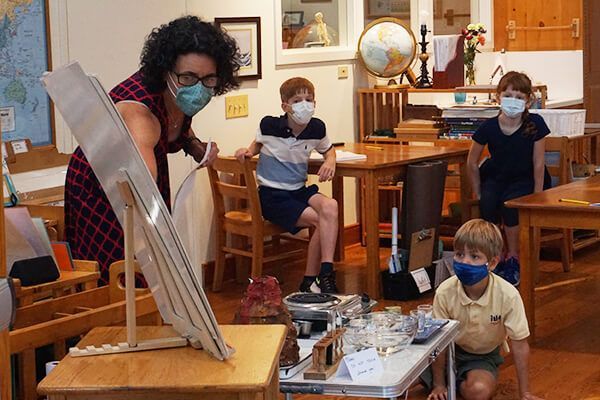
The Montessori Elementary curriculum is outlined by these five 20-minute Great Lessons, or oral stories, that the teacher tells to the children as a group. We begin every fall with the first story on the first day of school, and progress by telling each subsequent one every few weeks, in order. Each time new children join the class, the outline begins again to orient the new children and to continually reorient the older children. Though they hear the stories many times, the children enjoy them for their drama and imagination, and they hear something new in each retelling. More than anything, these stories feed the insatiable “but why?” questions for children ages six to twelve. Their numerous questions that only they can ask and which only they can answer for themselves, thus have a direct, central role in their educations.
The Five Great Lessons
I. The Story of the Universe, or God with No Hands, tells about the beginnings of the universe. In this story, “God” is a character with no hands, eyes, ears or mouth, and yet there’s some mysterious power of nature that caused the planets and the stars and everything that exists to be. It invites the children to wonder how this could be and to come up with their own theories.
Dr. Montessori told us, “If the idea of the universe is presented to the child in the right way, it will do more for him than just arouse his interest, for it will create in him admiration and wonder, a feeling loftier than any interest and more satisfying. The child’s mind then will no longer wander, but becomes fixed and can work. The knowledge he then acquires is organized and systematic; his intelligence becomes whole and complete because of the vision of the whole that has been presented to him, and his interest spreads to all, for all are linked and have their place in the universe on which his mind is centered” (To Educate The Human Potential).
This first story is therefore a springboard, which ignites children’s numerous questions. As they wonder about all sorts of things and seek more information to answer their questions, the teacher helps them learn to do original research and to express what they learn through their artwork, writing, presentations, musical compositions, or original dramatic productions. The study of planets, stars or our sun and earth are common paths of study. Because everything falls under the category of “the universe,” the possibilities are endless! Offshoots to this lesson are the study of astronomy, geology, physics and chemistry, which have many detailed lessons going up through age 12.
Now that the children have the framework of the Earth and where it is positioned, a few weeks later, we tell them what happened next on Earth.
II. The Coming of Life tells the story of the first forms of life and the spread of species as they evolved. There is a visual timeline that spreads across the floor to mark the passage of time and creatures. This orients the children in scientific eras and with layers of the earth. Students follow by seeking answers to with their own questions about plant and animal life. Offshoots are the study of ecology, biology, botany, and zoology, which have detailed lessons going up through age 12.
Now that the children have the framework of the universe, how the earth took shape, and how plant and life forms spread across it, we narrow in on ourselves:
III. The Coming of Human Beings tells the story of the evolution of human beings on Earth, from our origins onward, and what important survival features make human beings unique amongst all species. This story also has two timelines, the second one being a more detailed section of the first. There are large blank spaces on the timelines to invite the children to fill in with their own discoveries and to suggest that there is much more to be found out. Offshoots are the studies of all subjects of human history and cultures, as well as the interrelations of ecology, geology and human history.
Now that the children have the framework of the universe, the earth, the origins and evolutions of all life forms, and the orientation of human history, they are ready to explore two of humankind’s most important discoveries:
IV. Communication in Signs tells the story of why humans need to communicate with written symbols, or writing, beginning with the early cave drawings and continuing up through the emergence of our own alphabet. Follow-up lessons are all the language and arts lessons in the curriculum, including parts of speech, grammar, sentence structure and writing styles, composition and editing, artwork, and musical expression and composition, going up through age 12. Offshoots are the studies of other alphabets and languages, such as Latin and Greek roots and vocabulary, and writing styles.
Now that the children appreciate why and how human beings communicate for survival and progress, we introduce another creative discovery that is a language of its own—Mathematics:
V. The Story of Our Numerals explains the purpose for mathematics. Children discover why we need to measure, why we need numbers, and how number systems evolved from this necessity. When they recognize the sincere need for numbers and other aspects of mathematics, children become much more interested in the subject and its role in their own lives. Offshoots are the many lessons in mathematics, including geometry, precalculus, trigonometry, and mathematical word problems, in detail up through age 12.
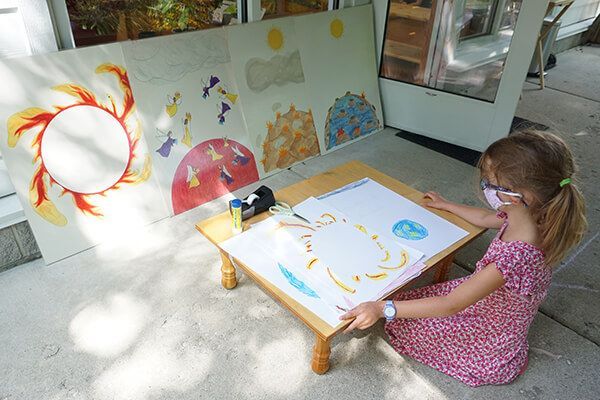
Once the children are oriented to all of the above, any and every piece of information they come across in their lives can find a logical place in their own, personal context built from hearing these stories over and again. The Great Lessons create a scaffolding, whether conscious or unconscious, for each individual child, for all their pursuits of knowledge in life.
A very common question is, “How can the Great Lessons be relevant if they remain the same? Isn’t it problematic that scientific discoveries change our views of history all the time, and that information is constantly evolving?”
I love this question because it gets at the very problem of how adults think of educating children: this question stems from the idea that teachers are the source of all information (not the environment in which the child lives and acts) and clings to the idea that the information is static in any given moment. In that common paradigm, information given must be the correct, most recent information on that day. This is why textbooks are constantly changing and conventional curriculums have to constantly update to try to keep up with human discoveries, a significant financial cost to schools. More importantly, that paradigm suggests to children that they must rely on adults to give them the absolute truth—that they cannot go and find it for themselves.
But the Great Lessons themselves are NOT meant to deliver absolute information nor even the latest information. The stories place the child, by the very nature of their telling, in the active position of explorer of information. Great Lessons are stories, based in facts, meant to inspire action. They excite the children to pursue the latest information and find out for themselves what is out there now. The child is the one who learns how to learn in this ever-changing world, where things are not just handed to us and we are not passive. The Montessori teacher’s job is to inspire and then model and guide students, to remove obstacles from their paths, and help them go on their own journeys of discovery. Children learn how to find information in books from the library, by finding local experts to interview, by forming their questions and by sharing what they learn and find with others around them when they write reports and give presentations.
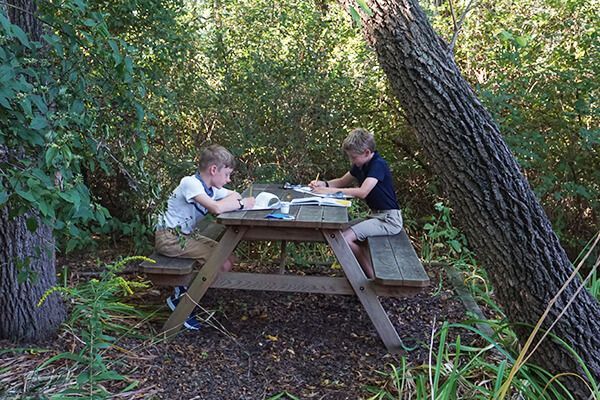
The Great Lessons are the starting points. They are not meant to teach, but to inspire an active process of going out into the world and seeking and acquiring information. This invites a new kind of mindset, one that much more accurately matches how human beings learn and how we make the great discoveries in life. The child becomes an adult who does not take everything others tell him as the absolute truth. He thinks, he participates, he searches. And he has so much fun doing all this! It is fun sharing information with others when you discover it on your own. School, and lifelong learning, is something to enjoy.
The Great Lessons and the follow-up work they inspire set a classroom of children in motion as a community. Dr. Montessori said, “To act in association with others in thought or practice is the only way in which [one’s] human nature can be active. All this shows clearly that education cannot be kept within the limits of a closed room in which the student remains inert and always dependent on the teacher while being kept separate from his fellow students. An education so limited is insufficient for children…The first reform in education must be to offer a wider environment and to multiply the possibilities of association and activity.” This relates to both the physical environment within and outside the classroom, and between children and their resources for information.
The flexibility for interpretation and mental association that the Great Lessons and their subsequent discoveries give to children also gets at the purpose of education: If our goal is to help children develop adaptability, to change with the times, to always approach the world in a relevant manner, this means that we must present information as something to seek out for oneself. To educate is to educate oneself as an active quest, one that never ends but continues all throughout life.
This is difficult to do without a framework that orients the learner. Children have the courage and intelligence to explore further and to make new and meaningful discoveries only when they have the security that comes from having first built an established framework within. The Great Lessons expertly serve this purpose.