The pervasiveness of technology in our culture brings the support of technology in our everyday lives. Thanks to tools such as autocorrect, proofreading, ChatGPT, and other on-line sites, any piece of writing can be thoroughly checked and edited for grammar. They make corrections and suggestions, ensuring that documents are properly vetted before being shared in any format.
These incredible and useful tools have had the secondary effect of a greater reliance on them for writing. Now, students and adults alike are inclined to depend on technology to fix their grammar rather than learning how to get it right in the first place. To a certain extent, it is helpful to have assistance in fine-tuning work. But issues arise when people simply stop learning how to utilize correct grammar.
Thankfully, a Montessori education has a comprehensive and engaging curriculum for teaching the intricacies of grammar to students. It starts at age five, with concrete experiences with the function of words, and ends at age twelve, with elaborate sentence analysis. Then, in seventh and eighth grade, students have opportunities to rigorously apply the lessons they have learned in the more complicated projects they produce at this age.
The Argument for Grammar
Grammar matters. Knowing proper grammar matters. No matter how much help someone can get from technology, understanding how words fit together and how meaning changes based on word placement will always be important. There are many reasons for this. First of all, there is (currently) no way for an autocorrect feature to monitor when someone is speaking. People need to have a proficient sense of sentence structure and syntax for verbal conversations. This will impact how well they are able to communicate and how they are perceived in the world at large.
Secondly, grammar in itself provides value because of the parts of the brain that are in use when we learn about and utilize language. Everything that we learn employs the brain in slightly different ways. This allows our minds to develop fully and to stay active and nimble as we age. Underuse sets aside parts of our brains and they grow weaker. It is important to give our minds, especially young ones, a variety of different activities and lessons to absorb. This strengthens thinking and helps provide a robust infrastructure of neuronal connections.
Finally, great ideas and well-developed thinking do not develop in a vacuum. Words bring thoughts to life, and words further develop nascent thoughts. Having an accurate way to express internal ideas allows those ideas to enter the known world and come to fruition in a finalized product. A sense of grammar is like a sturdy structure to hang creativity and imagination on. It provides a foundation for the building of new thoughts and the expression of those thoughts.
The Montessori Way
Dr. Montessori’s approach for all academic matters is to bring the topics alive for the children. This means that students are given ways to experience lessons through movement and through the manipulation of physical materials that are beautiful and engaging. The subject matter is introduced in a way that is personal and meaningful. In this way, learning is a dynamic and captivating process, meant to encourage the children along on their path to discovery.
Take a moment to remember how you learned grammar in conventional school. Perhaps there was a year when a gifted teacher found a way to make learning about nouns, direct objects, and transitive verbs fun. But it is likely that you mostly remember worksheets, textbooks, and sentences taken out of context for the class to analyze rotely. Taken this way, it is no wonder that grammar is often a dreaded, and thus avoided, topic in traditional schools. It is made up mostly of dry lessons, unrelated to life or to communication that feels compelling and interesting to students.
In the Montessori curriculum, the children first learn about grammar with their bodies as they experience the way different parts of speech show up in real life. They learn more about parts of speech through appealing objects that entice their imagination. And they learn about reading (or sentence) analysis through colorful materials, socially productive group work, and their own creativity and passions as they mine their imagination and the books around them for sentences to understand more deeply.
Grammar for Young Children (3-6)
Parts of Speech
Three- to six-year-olds learn grammar in a highly concrete way. This begins with the parts of speech as soon as children are reading well, usually some time after age five. The teacher introduces the children to each category in turn (article, adjective, noun, conjunction, preposition, verb, adverb) in ways that are concrete and also physical within their bodies.
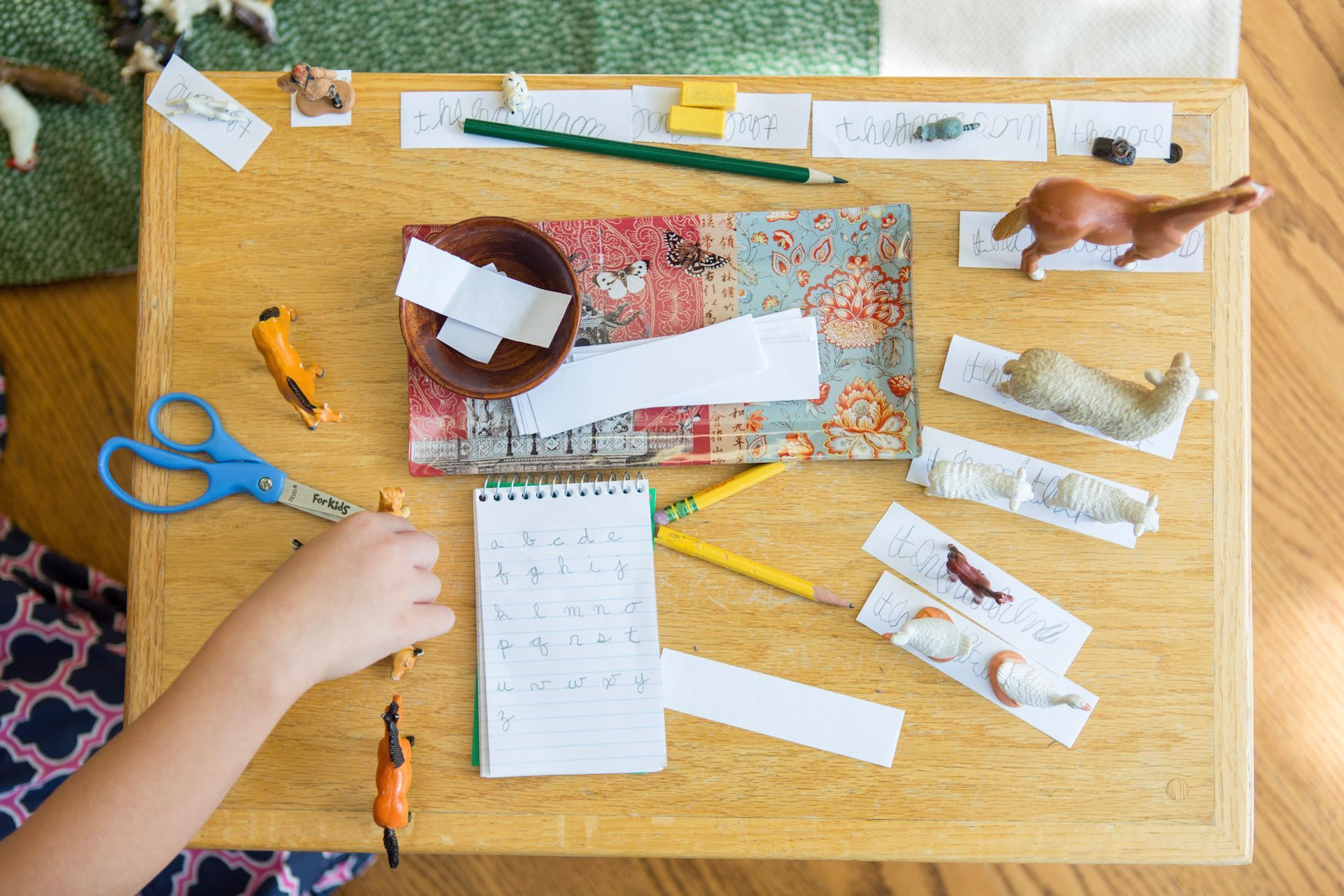
Articles, adjectives, and nouns are all represented through an activity known as “The Farm,” with small animals that the children learn to differentiate through the identifying words that relate to objects (articles, adjectives, and nouns, followed by conjunctions and prepositions). The children choose and name each object by writing on a slip of paper (e.g., “The big pig” / article, adjective, noun) and then place them in relation to each other, using conjunctions and prepositions (e.g., “The big pig and the brown horse behind the red barn”). Then they symbolize each part of speech with shapes meant to represent the concept behind each part of speech. Articles, adjectives, and nouns are all differently sized and color triangles, indicating their relation to each other. A conjunction is a pink line, like a pink ribbon tying two items together. A preposition is a green bridge, showing the way the word bridges a connection between two objects.
Once children are comfortable with these parts of speech, the teacher will move on to verbs. Here, the teacher will write an action word, such as “jump” on a slip of paper. They will then ask questions meant to elicit the understanding that an action word is not something you can hold or see. It is something you have to do with your body. Children experiment with all sorts of different action words (symbolized by a red circle, meant to represent movement). Then they learn about adverbs which tell them how to do the verb (represented by an orange circle to show its relation to the verb).
Exploration with parts of speech continues as the students have different “games” that reveal different ways that adjectives and adverbs relate to nouns and verbs. All of these activities further cement their understanding of the nature of different kinds of words. They come to know them intimately. They also learn about tenses, interior verbs, transitive and intransitive verbs, and the ways that words can change function. All of these lessons are presented in ways that allow the children to experience the concepts in their bodies.
Reading Analysis
Next, students learn about reading analysis, where they come to understand the functions of words in sentences. First, the teacher writes sentences that are interesting and meaningful to the student, often using their name or the names of their friends (e.g., “William ran and jumped.”). William then acts out the sentence. The teacher asks, “What are the action words?” When William says “ran” and “jumped”, the teacher asks him to cut out those words and place them on red circles (representing the predicate, or verbs in sentences). Then she asks, “Who is it that ran and jumped?” When William says “William,” the teacher places a black arrow from each of the red circles, both pointing to the slip of paper with “William” on it, while “and” is placed between the two red circles. She then reads back, “William ran and jumped” and transposes the two predicates, asking if the meaning is the same. The child will say yes, and then she will return the verbs to their original circles.
This exercise will become more and more elaborate in an organized and specific way, introducing sentences with two subjects and two predicate; one subject, one predicate, and one object; one subject, one predicate, and two objects; two subjects, two predicates, and two objects; the addition of pronouns; and the addition of commas. Each lesson is given the same way, with the child acting out the part, answering questions to lay out the structure, transposing the words to see if the meaning changes, and then returning the sentence to its original form. These progressively complex exercises deepen their understanding of the functions of words and the ways that sentences are structured.
Finally, teachers give lessons with wooden circles and arrows with the questions already written on them so the children can fully absorb which questions point to which functions within the sentence (e.g., for indirect objects: “William polished the silver.”) The child always first identifies the action word (“polished”) and puts it on the red predicate circle. Then, the black “object” arrow asks “Who is is that? What is it that?” so that the question reads “Who is it that or what is it that polished?” William will say, “William” and place the “William” slip on a black circle to the left of the red predicate circle with the black object arrow pointing at it. The black “indirect object” arrow asks “Whom? What?” so the question will read “William polished whom or what?” William will say “the silver” and then place “the silver.” slip of paper on the smaller black indirect object circle to the right of the red predicate circle with the direct object arrow pointing at it. William will read the sentence, transpose the indirect object and object to see if the meaning changes (which it will!) and then return it to its original form. From here, the sentences will become more complicated, introducing adverbs, attributes, and appositives, all building a stronger foundation for grammar.
Grammar for the Elementary Student (6-12)
Parts of Speech
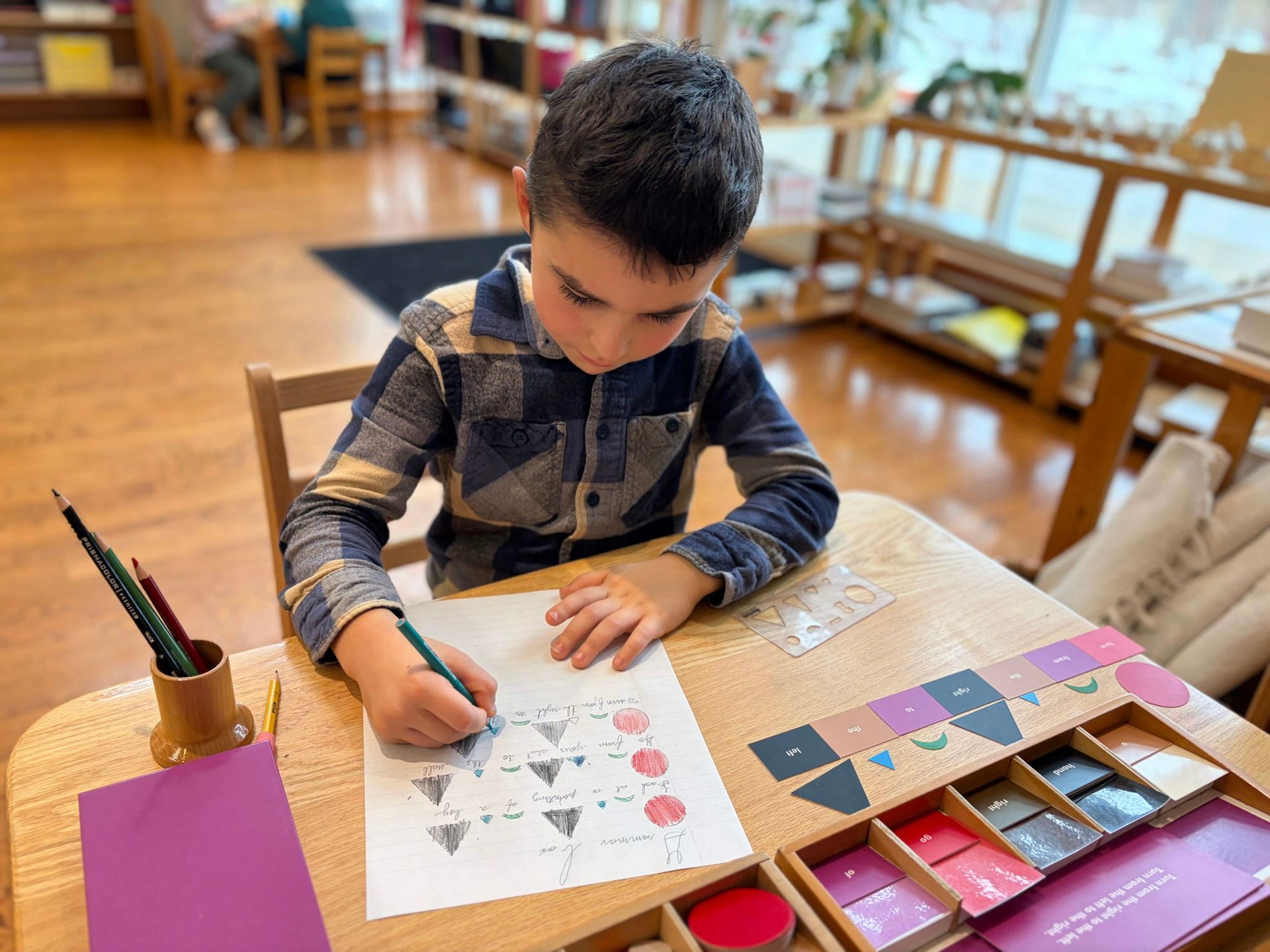
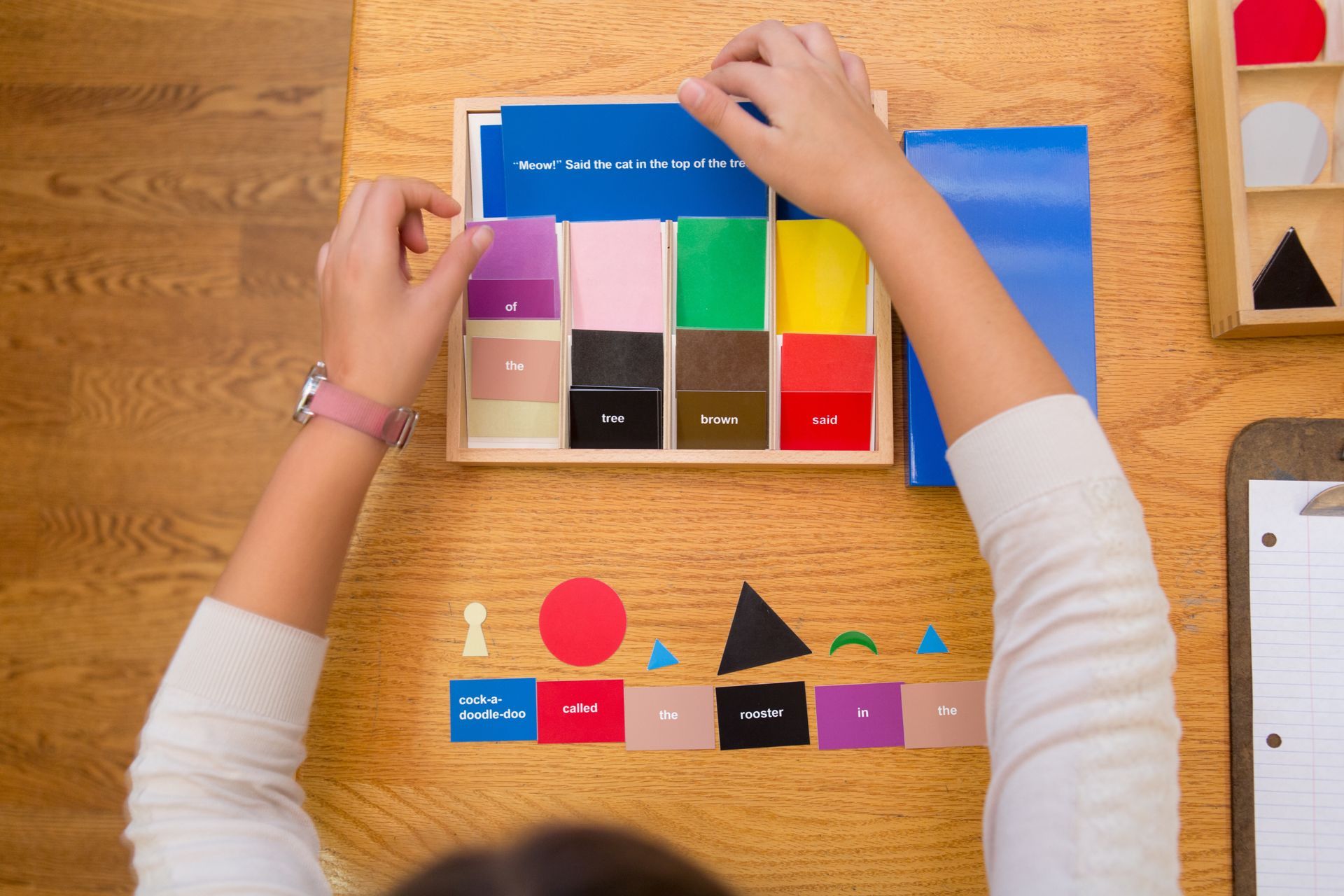
The main work of the elementary student in learning parts of speech is done through the “Grammar Boxes.” This activity is usually done by two students together, as children of this age are highly motivated by social interactions. There is one box for nouns, one for adjectives, one for verbs, and so on. Each box has a set of large cards with at least two sentences with actions for the children to act out and a set of small cards made up of all the words in the sentences on the large cards.
Once they act out the first sentence on the large card, they search through the accompanying small cards (one for each word in the command) to produce the sentence in its entirety on the table in front of them. These cards are color coded by parts of speech. Then, the children return to the large card and read the next sentence. In this second sentence there will be some sort of difference that highlights the part of speech of this grammar box (e.g., swapping “noisily” for “quietly” to highlight how an adverb changes the meaning of the sentence). The children act out the second command and then change the small card on the table in front of them so the sentence matches. After completing all the commands, the children go through the sentence to symbolize each word with the special shapes that signify each part of speech.
This activity brings the words to life in front of the children. They physically move their bodies, and feel the way that the words change their actions. They manipulate the beautiful, colorful cards to experience the way that the words relate to each other. They use their own powers of deduction to draw meaning from the activity.
Alongside the Grammar Boxes, the children also play games and work with inviting cards and charts that allow them to explore topics, such as noun classification (proper and common, concrete and abstract, etc.); adjective comparison (longer, longest); pronominal, numerical, and proper adjectives; a great deal of verb tense work; and more exploration of the other parts of speech, all presented in similar ways. These activities involve movement, creativity, and engaging materials and invite the children to explore, guided by their own curiosity and interest.
Reading Analysis
Reading analysis picks up where the Primary student leaves off, examining simple, complex, and compound sentences using the same arrows with questions that the children can read themselves in order to categorize the different parts of their sentence. They learn the names of these different parts from those same arrows (subject, direct object, attributive, and adverbs known by time, place, cause, agent, etc.). This work becomes more advanced as they learn about clauses. At this age they also will work with charts that further explore syntax, while also encouraging the abstraction of these concepts.
These sentences are not assigned by the teacher. They are not found on worksheets or in workbooks. Instead, the children work in small groups and create little stories with each other, using their names or the names of their friends. They imagine stories and share anecdotes about their lives. They mine poetry and their favorite books. They explore the Constitution and other historical documents. They see that sentences are all around them, and that they can come to know their language more thoroughly through reading analysis work. And through all of this, they stay joyful, curious, and motivated to learn about grammar—a gift that will always stay with them.
Final Thoughts
While the systems to edit for proper grammar have only grown more prolific and effective, the necessity of understanding how words fit together has not diminished. Usage evolves over time, but our relationship to the conventions and customs of our language will always matter. It affects how others perceive us, it allows us to maximize and develop the utilization of our brains, and it is the literal framework upon which ideas are cultivated and shared. The systems that technology makes possible are useful, but they should not supplant a nuanced knowledge of grammar and its usage.
Language is, perhaps, the most powerful tool that human beings have. It is how we know others and make ourselves known. We can use it to express love, frustration, anger, and delight. It is how we share our ideas and thoughts with friends, neighbors, and our community. Language allows us to connect with others across the globe and from generations past to generations to come. This tool is a gift, and just like with any tool, it requires care and attention or it will lose its potency. It is up to us to ensure that our children love and respect it, and understand the incredible power and gifts that it offers us.